The Wolf of Wall Street, FINRA, and the Jury Trial That Might Have Been
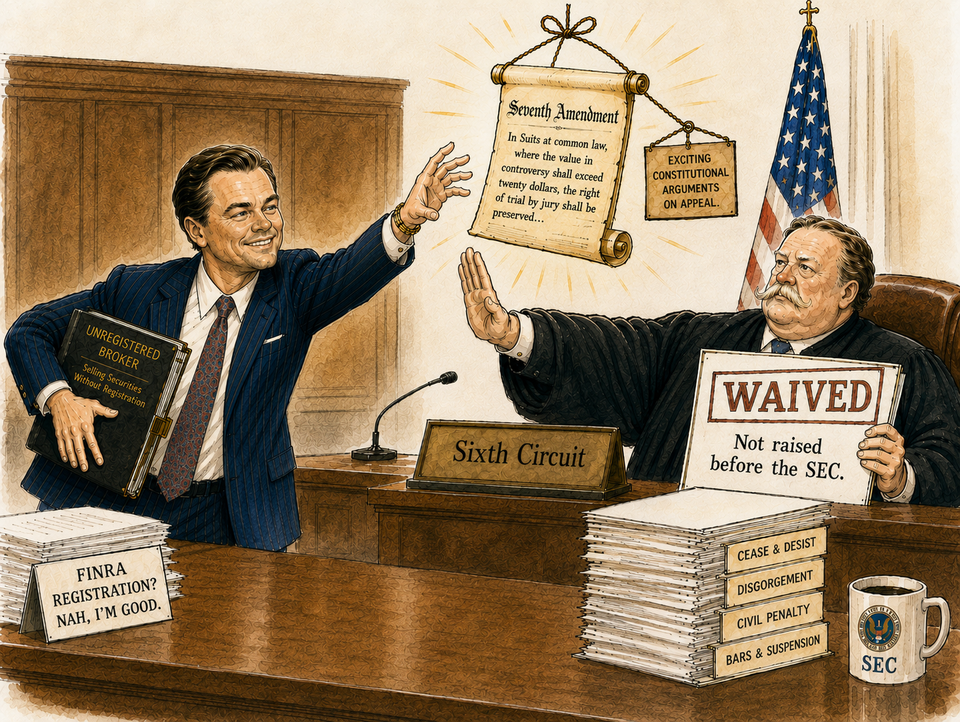
It isn’t every day that the Sixth Circuit explains, in patient detail, the victory the losing party gave away, but Smith v. SEC, No. 24-3907 (6th Cir. June 16, 2026), is that rare opinion. Judge Readler opens with Martin Scorsese’s blockbuster movie The Wolf of Wall Street: Jordan Belfort, the Series 7 exam, and the long arm of the Securities and Exchange Commission. (We also learn that The Wolf of Wall Street is Scorsese’s highest-grossing movie; that may be, but we all know Raging Bull is his best.) The allusion is built on a contrast — Belfort registered, got rich, and got caught. Petitioner Eric Smith never registered at all but still ended up “in the SEC’s crosshairs.” That refusal to register sits at the center of this case.
The man who wouldn’t register
Smith founded Consulting Services Support Corporation in 1998 and ran it as chairman, CEO, and majority owner. One of its subsidiaries, CSSC-BD, was a registered broker-dealer and a member of the Financial Industry Regulatory Authority (the private, self-regulatory body that polices the securities industry under the SEC’s supervision). Smith insisted that he personally was exempt from registering so long as he stayed out of CSSC-BD’s securities business. The facts were less tidy: between 2010 and 2015 he ran three debt offerings, directed the firm’s representatives to sell the bonds, larded the last offering with false statements, and personally drew $130,000 from four investors. After a routine examination and investor complaints, FINRA charged him, ruled against him, barred him from associating with any member, and ordered $130,000 in restitution. The SEC affirmed. Smith then petitioned the Sixth Circuit for review; the court denied it.
The losing argument Smith kept
Smith made two arguments at the Sixth Circuit, one he preserved, and one he didn’t. Start with the one he didn’t forfeit. Smith told the Sixth Circuit that FINRA had no business disciplining him given that he never joined the organization. The court disagreed, explaining that the statute reaches more than members. FINRA has disciplinary power over “persons associated with its members,” 15 U.S.C. § 78o-3(b)(7), and the definition of “person associated with a member” sweeps in “any person directly or indirectly controlling . . . such member,” § 78c(a)(21). That was enough to encompass Smith, who controlled CSSC-BD, which indisputably was a FINRA member. Smith’s real objection — that a private organization should not be enforcing federal law against someone who never consented to its authority — was, the court said, “primarily a quibble with Congress.” (Smith had also raised private-nondelegation and Appointments Clause challenges, then withdrew them once FINRA conceded that it acts “subordinately” to the SEC as an “aid.”)
The winning argument that Smith lost
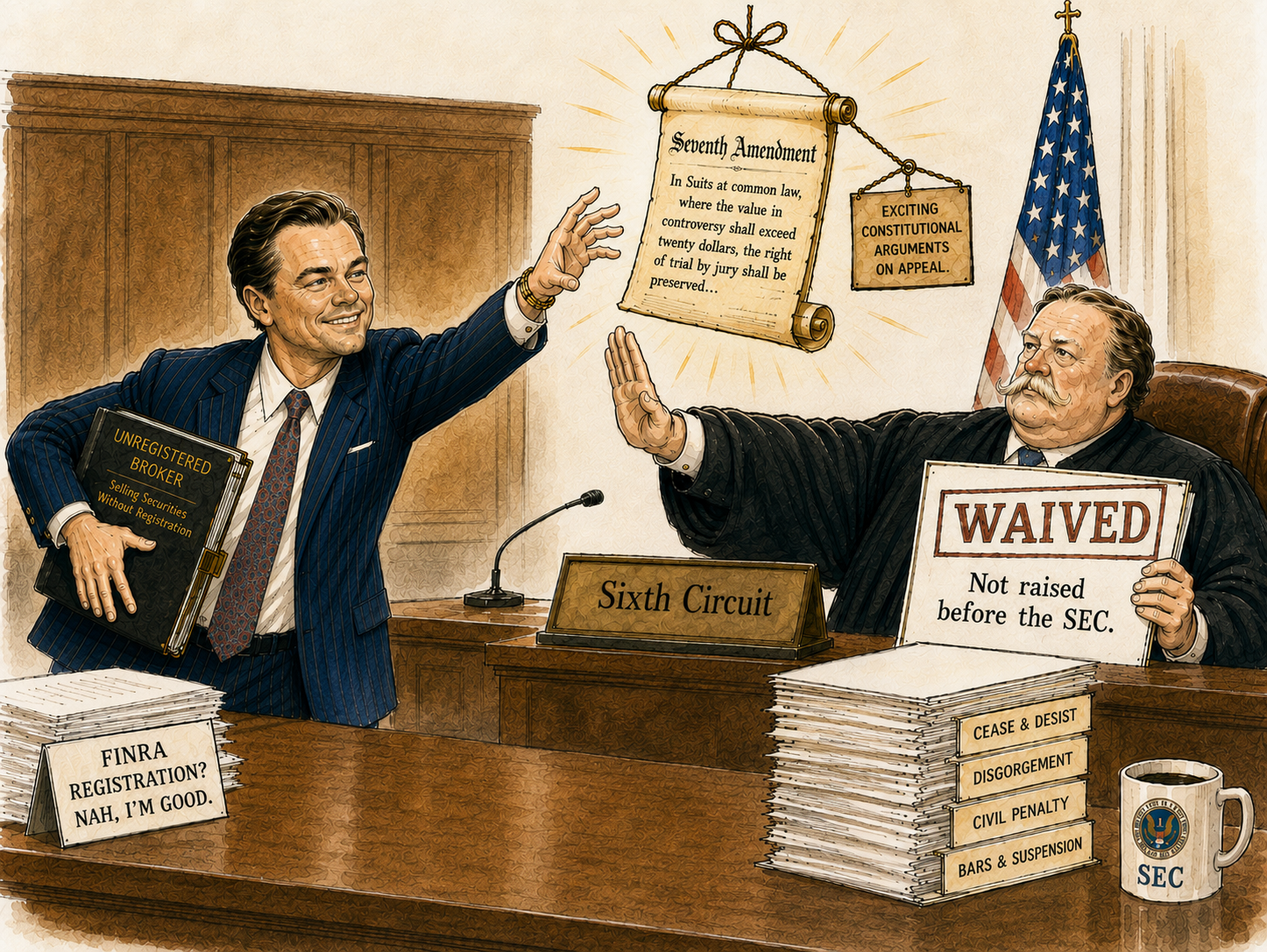
Smith’s other argument was the good one but dead on arrival. Smith argued that, under SEC v. Jarkesy, 603 U.S. 109 (2024), he had a Seventh Amendment right to a jury in an Article III court. The problem was that Smith never made that argument to the SEC. By statute, no objection “may be considered by the court unless it was urged before the Commission or there was reasonable ground for failure to do so.” § 78y(c)(1). Smith offered three reasons for his silence, and the court rejected each. The SEC was not incompetent to hear constitutional claims; in fact, it hears them often. Jarkesy was not an intervening change in law, and, in any event, it came down while his case before the SEC was still pending. Nor would raising the issue have been futile.
That last point is worth a mental note. Futility, the court explained, is not about whether you will lose; it is about whether the agency is “powerless to grant the relief requested.” Smith “confuse[d] results for remedies,” the court said. Even a certain loser must make his argument, because a litigant “is not excused from making an argument before an agency simply because the argument is destined to lose.” The SEC could have vacated the FINRA sanctions and brought the matter in federal court, where Smith could have demanded his jury. That was remedy enough to require him to ask.
The road not taken
Having shut the door, the court nonetheless described the room behind it. Judge Readler wrote that, “had Smith raised his constitutional challenge before the SEC, he may well have been entitled to a jury trial in federal court.” Walking through Jarkesy, the majority found the SEC’s case against Smith exceedingly difficult to distinguish: the same anti-fraud provisions, with “an enduring link” to common-law fraud, and a restitution order that looked a lot like a legal remedy — money to be paid out of Smith’s own pocket and owed to FINRA itself if no victim could be found. On the public-rights question, the historical tradition the government leaned on was one of consenting members regulating themselves, but the majority was unmoved. After all, Smith had consented to nothing; he had declined to register with FINRA. And “the SEC [did] not point to any historical tradition allowing SROs to discipline non-consenting non-members.” Ultimately, however, “these points [were] all for naught” because of Smith’s forfeiture.
Whether the court should have said any of it divided the panel. Judge Bloomekatz, concurring only in the judgment, objected that the majority had spent “many pages” opining on a constitutional claim it could not decide. That didn’t stop Judge Murphy from writing his own concurrence pressing a different constitutional question altogether: whether Congress may make consent-to-no-jury the price of a brokerage license at all. In an earlier time, he observed, brokers who disliked an exchange’s rules could trade on “the streets” (or a restaurant or coffeehouse). Now federal law puts them to a choice: “consent to forgo those constitutional protections or stay out of the brokerage business.” And that, Judge Murphy suggested, may be an unconstitutional condition waiting for a challenger.
The takeaway for practitioners
Preserve the structural argument, or lose it. Jarkesy may have paved the way for a new line of attack on agency adjudication, but § 78y(c)(1) demands that the argument be made to the agency first, even when everyone knows the agency will say no. Don’t mistake a hopeless argument for a futile one; the exhaustion statute doesn’t. Note the new decision, file the supplemental brief or move for reconsideration. The price of raising a doomed point before the Commission is the right to raise a (potentially) winning one in court.
And FINRA’s critics should note what the court could not hold. The opinion is studded with signals that FINRA’s power to discipline someone who refused to join it, in the absence of a jury or Article III judge, rests on shaky constitutional ground after Jarkesy. What saved the government here was not the merits but the petitioner’s procedural misstep. The next broker who preserves the issue may well receive the jury trial Eric Smith forfeited by failing to raise it below.