NOT RECOMMENDED FOR PUBLICATION
UNITED STATES COURT OF APPEALS FOR THE SIXTH CIRCUIT
Darma Canter v. HSD II, LLC
Western District of Michigan at Grand Rapids
BeforeMcKEAGUE, READLER, and BLOOMEKATZ, Circuit Judges.
McKEAGUE, J., delivered the opinion of the court in which READLER, J., concurred. BLOOMEKATZ, J. (pp. 22–44), delivered a separate opinion concurring in part, dissenting in part, and dissenting from the judgment in part.
View the official PDF → · unofficial reading copy; the court’s PDF controls
McKEAGUE, Circuit Judge. This case is about an Americans with Disabilities Act (“ADA”) regulation: the 60% Rule. The 60% Rule states: “at least 60 percent of all public entrances shall comply with [section] 404 [of the ADA minimum accessibility regulations].” 36 C.F.R. pt. 1191, app. B § 206.4.1. Section 404 of the regulations, in turn, establishes specific requirements for doors, doorways, and gates. 36 C.F.R. pt. 1191, app. D § 404.
Darma Canter sued Crue Hair, Inc. (a barber shop) and HSD II, LLC (Crue Hair’s landlord) alleging a violation of the 60% Rule. According to Canter’s understanding of the regulation, a public accommodation with only two entrances must make both of those entrances fully accessible. Because one of Crue Hair’s two entrances is raised and unramped, Canter claims it violates the ADA.
The district court disagreed with Canter’s interpretation of the 60% Rule. To the district court, compliance with section 404 pertains narrowly to doors, doorways, and gates; section 404 does not govern the elements leading up to doors, doorways, and gates. Because we, like the district court, hold that the text of the 60% Rule does not require 60% of public entrances to be fully accessible—it only dictates that 60% of public entrances have doors, doorways, and gates that meet section 404’s minimum requirements—we AFFIRM.
I. BACKGROUND
A. Factual Background
Heritage Square Commons is a small mixed-use development in downtown Muskegon, Michigan. One of its commercial tenants—Crue Hair—is a local barber shop located on the ground floor. HSD owns Heritage Square Commons and leases the commercial space to Crue Hair.
According to the lease, HSD “shall, at all times during the Term, maintain the exterior and structural interior portions of the building.” Lease Agreement, R.30-1 at PageID 114. Crue Hair could request permission to make “Leasehold improvements,” but “[a]ny improvements made, even if approved by [HSD], must be removed by [Crue Hair] upon the expiration of the Lease and the Premises returned to its original condition unless otherwise agreed in writing.” Id. at PageID 120. Additionally, HSD “agree[d] to maintain or repair any circumstances relating to the initial construction of the Premises which do not conform to municipal and State ordinances affecting [Crue Hair]’s use of the Premises and will hold [Crue Hair] harmless from penalty, damage or other charges imposed for any violation of said ordinances or laws.” Id. at PageID 121. The parties proceeded under this arrangement for all times relevant to this case.
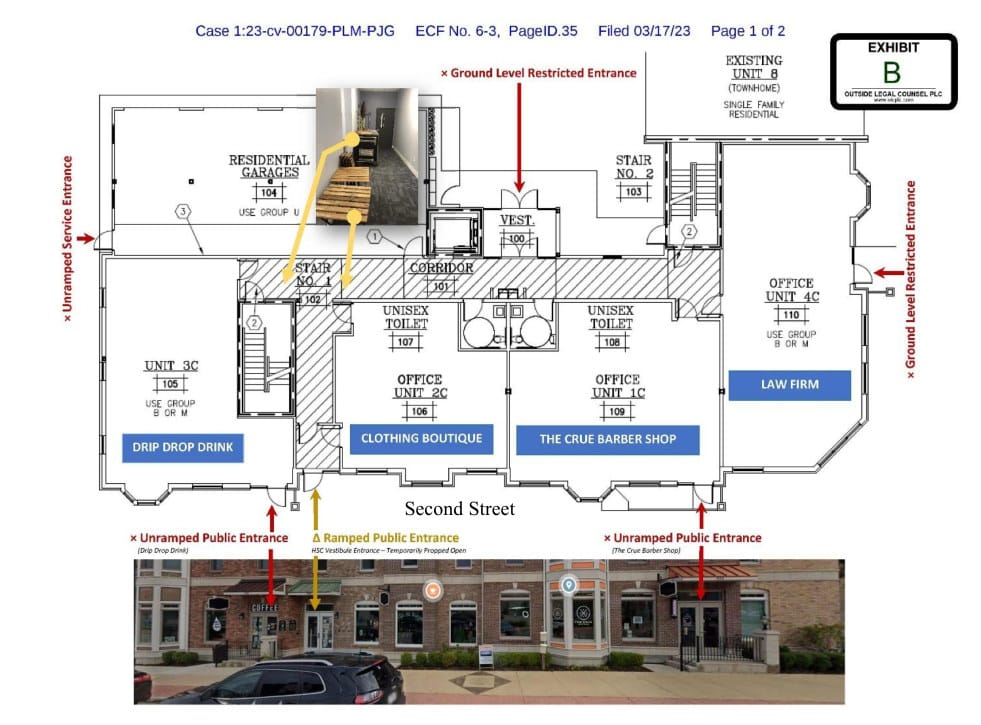
Heritage Square Commons has multiple entrances, as shown in the image above. Relevant to this appeal, there are three entrances on the building’s front facade along Second Street in Muskegon. One is a raised, stepped entrance leading directly to Crue Hair. The second is a raised, stepped entrance leading directly to the commercial space formerly occupied by Drip Drop Drink (a coffee shop that went out of business during the district-court litigation). The third is a handicap- accessible vestibule entrance that leads to a corridor. From this corridor, members of the public can access each of the commercial tenants, including Crue Hair (and the space formerly occupied by Drip Drop Drink). Crue Hair has only two public entrances leading into its barber shop—the stepped entrance on Second Street, and a rear entrance accessible through the vestibule and corridor.
Enter Darma Canter. Canter suffers from Charcot-Marie-Tooth disease, a hereditary neuropathy condition that impacts her mobility. She uses a walker throughout her daily life and has difficulty with stairs.
Canter is passionate about ADA accessibility. She belongs to numerous groups that advocate for increased accessibility at public accommodations. As part of her efforts, Canter travels to downtown Muskegon to survey whether buildings and public infrastructure are ADA- compliant. The Heritage Square Commons development caught her attention.1. Canter’s daughter, Eleanor, was also involved in these efforts—she questioned whether Heritage Square Commons was ADA-compliant, and she was involved in a lawsuit when Disability Network West Michigan started to work with Heritage Square Commons on alleged ADA violations. See Canter v. Disability Network W. Mich., No. 22-1856, 2023 WL 5627318 (6th Cir. Aug. 31, 2023). While HSD refers to that case throughout its brief (in what appears to be an attempt to paint Canter and her daughter as harassing plaintiffs), that case did not address any ADA compliance issues and instead focused on defamation and retaliation claims. Id. It is irrelevant for purposes of this appeal.
Canter was concerned about access to the commercial tenant spaces, and she took issue with the building’s front facade on Second Street. In particular, she questioned why the public entrances that went directly from Second Street into commercial spaces were raised and unramped. To Canter, it made no sense to force individuals with mobility-based disabilities to travel down a corridor while able-bodied individuals could enter commercial spaces directly from Second Street.
Canter visited Heritage Square Commons multiple times, predominantly to visit Drip Drop Drink. However, after one of Canter’s trips to the coffee shop to meet up with a friend, she wanted to visit Crue Hair to pick up gift certificates for her sons to get haircuts. Unable to locate Crue Hair’s rear entrance, Canter gave up and left. She testified that she would have entered Crue Hair through the front entrance if not for the steps. Based on her experiences at Heritage Square Commons, Canter felt these businesses were violating the ADA, so she sued.
B. Procedural History
Canter filed a lawsuit against HSD and Crue Hair under the ADA.2. Originally, Canter also sued Drip Drop Drink, but she voluntarily dismissed the coffee shop from the lawsuit after learning the business no longer operated. She asserted multiple theories of disability-based discrimination. First, she claimed each defendant failed to comply with the 60% Rule, a regulation-based accessibility threshold for public entrances. Second, Canter claimed each defendant was violating the ADA by forcing disabled individuals to travel down a (sometimes locked) corridor to enter public accommodations. To Canter, this amounts to discrimination because “disabled patrons are essentially required to travel substantially greater distances before gaining access to the same service that all other patrons receive,” while able- bodied individuals could use the more convenient raised, unramped entrances. Compl., R.1 at PageID 4. Canter sought prospective relief—she wanted Defendants to make reasonable modifications and remove any barriers to Heritage Square Commons to allow disabled persons equal enjoyment and access to the on-site public accommodations.
The district court granted summary judgment to the defendants. First, the district court concluded that Crue Hair could not be liable for the alleged violations because it had no control over the exterior entrances. Then, the district court determined that Canter failed to establish any ADA violations. This appeal followed.
II. STANDARD OF REVIEW
We review the district court’s grant of summary judgment de novo. Home Depot, Inc. v. Steadfast Ins. Co., 125 F.4th 769, 774 (6th Cir. 2025). Summary judgment is appropriate where “there is no genuine dispute as to any material fact and the movant is entitled to judgment as a matter of law.” Fed. R. Civ. P. 56(a).
III. ANALYSIS
Canter raises two issues on appeal. First, she claims the district court misinterpreted the 60% Rule, arguing that the regulations require 60% of public entrances to be completely accessible—i.e., reachable by an accessible route. Second, she claims Crue Hair should be jointly liable for ADA violations relating to its raised, unramped entrance even though it lacks control over that entrance per the terms of its lease with HSD.3. Canter’s rebuttal during oral argument marked the first time her counsel argued that Crue Hair maintained shared control of the exterior entrance, relying on a selective citation to the lease. Because we hold that Canter did not establish an ADA violation, our analysis starts and ends with the first issue.4. As noted above, apart from her challenge under the 60% Rule, Canter pressed a separate theory for her ADA violation at the district court: that requiring disabled individuals to travel “substantially greater distances” through the accessible corridor to reach the desired services amounted to unequal treatment under 42 U.S.C. § 12182. Compl., R.1 at PageID 4; see also Pl.’s Mot. for Summ. J., R.50 at PageID 225. The district court determined that Canter did not establish an ADA violation under this theory. Canter did not challenge that holding on appeal.
To succeed in her ADA discrimination claim, Canter must show that (1) she is “disab[led]” within the meaning of the ADA, (2) she was denied “the full and equal enjoyment of the goods, services, facilities, privileges, advantages, or accommodations of any place of public accommodation” due to her disability, and (3) she was denied equal enjoyment “by” a defendant who “owns, leases (or leases to), or operates [the] place of public accommodation.” 42 U.S.C. § 12182(a); see also Camarillo v. Carrols Corp., 518 F.3d 153, 156 (2d Cir. 2008) (per curiam); Reinoehl v. Whitmer, No. 22-1343, 2023 WL 3046052, at *2 (6th Cir. Apr. 17, 2023) (per curiam order) (citing Camarillo, 518 F.3d at 156); La Riccia v. Cleveland Clinic Found., No. 21-3990, 2022 U.S. App. LEXIS 142, at *3-4 (6th Cir. Jan. 4, 2022) (per curiam order) (citing Camarillo, 518 F.3d at 156). There is no dispute that Canter is disabled within the meaning of the ADA. We thus turn to whether she provided sufficient evidence to show she was denied the full and equal enjoyment of Crue Hair (and we do not reach the third element).
The ADA prohibits discrimination based on an individual’s disability. 42 U.S.C. § 12101(b); PGA Tour, Inc. v. Martin, 532 U.S. 661, 674-75 (2001). In Title III of the ADA, Congress specifically prohibited disability-based discrimination at places of public accommodation, including barber shops. 42 U.S.C. §§ 12182(a), 12181(7)(F). The protection is broad: “[n]o individual shall be discriminated against on the basis of disability in the full and equal enjoyment of the goods, services, facilities, privileges, advantages, or accommodations of any place of public accommodation.” Id. § 12182(a). And while discrimination can come in many forms, relevant to this appeal, a public accommodation violates the ADA by “fail[ing] to remove architectural barriers” that prevent disabled individuals from sufficiently accessing places of public accommodation. Id. § 12182(b)(2)(A)(iv).
Congress directed the Attorney General to issue regulations that carry out these anti- discrimination provisions. Id. § 12186(b). Among other things, the Attorney General was tasked with promulgating technical standards that outline the minimum accessibility requirements for public accommodations and establish the types of architectural barriers that places of public accommodation need to remove to comply with the ADA. Id.; see also 36 C.F.R. pt. 1191, app. B § 101.2. But the Attorney General was not to start from scratch; the accessibility standards must “be consistent with the minimum guidelines and requirements issued by the Architectural and Transportation Barriers Compliance Board” (“Access Board”), which is a separate federal agency. Id. § 12186(c); 29 U.S.C. § 792 (establishing the Access Board); see also Miller v. Calif. Speedway Corp., 536 F.3d 1020, 1024-25 (9th Cir. 2008). After initially promulgating the relevant standards in 1991 (adopting the Access Board’s minimum requirements), the Attorney General updated the standards in 2010 (adopting a newer version of the Access Board’s minimum requirements). 28 C.F.R. § 36.104. All parties agree that the 2010 version of the regulations (the “2010 Standards”) govern this dispute. See 28 C.F.R. §§ 35.151(c)(3), 36.406(a)(1).
Canter’s appeal centers on one of these minimum-accessibility requirements: the 60% Rule. According to this rule, “at least 60 percent of all public entrances shall comply with [section] 404 [of the regulations].” 36 C.F.R. pt. 1191, app. B § 206.4.1. By the 60% Rule’s plain terms, because there are two public entrances to Crue Hair’s leased space, both must comply with section 404 of the regulations.
HSD argues that we should zoom out and look to Heritage Square Commons’s entrances, not Crue Hair’s entrances. But this framing misstates Canter’s claims and the relevant inquiry. Canter’s lawsuit alleges that Crue Hair fails to “maintain two accessible public entrances under the 60% Rule.” And her appeal focuses on that alleged failure. The ADA regulations require each public accommodation to comply with the 60% Rule, not merely the larger building that houses the public accommodation. 28 C.F.R. § 36.102.
The 60% Rule applies to “all public entrances.” 36 C.F.R. pt. 1191, app. B § 206.4.1. A “public entrance” is “[a]ny access point to a building or portion of a building or facility used for the purpose of entering” “that is not a service entrance or a restricted entrance.” Id. § 106.5 (defining “entrance” and “public entrance”). That includes interior entrances that lead to tenant spaces. See id. §§ 106.5 (defining “service entrance,” “restricted entrance,” “public use,” and “space”), 206.4.5 (describing a “tenancy” as a “Tenant Space”); see also 28 C.F.R. § 36.104 (defining a “public accommodation” as “all or any portion of buildings, structures, sites, [or] complexes” “whose operations affect commerce,” including “barber shop[s]”). Putting the definitional puzzle together, this means Crue Hair’s public entrances must comply with the 60% Rule.
The question becomes: do both of Crue Hair’s public entrances comply with section 404? Canter says no. Why? Because one of Crue Hair’s public entrances is raised and unramped. According to Canter’s interpretation of the accessibility requirements, for Crue Hair to comply with the 60% Rule, there must be a ramp that leads to the barber shop’s stepped Second Street entrance. But the text, structure, and history of the regulations indicate that Canter misinterprets the 60% Rule and what constitutes compliance with section 404 (which specifically governs doors, doorways, and gates).
A. Text of the Regulations
For questions of regulatory interpretation, we start with the text. Saginaw Chippewa Indian Tribe of Mich. v. Blue Cross Blue Shield of Mich., 32 F.4th 548, 557 (6th Cir. 2022). The 60% Rule comes from section 206.4.1 of the 2010 Standards. 36 C.F.R. pt. 1191, app. B § 206.4.1. It states: “at least 60 percent of all public entrances shall comply with 404.” Id. The parties agree that “shall comply with 404” refers to section 404 of the 2010 Standards. Turning to section 404, that section outlines minimum requirements for doors, doorways, and gates. 36 C.F.R. pt. 1191, app. D § 404. So, by its text, the 60% Rule is simple: 60% of public entrances must comply with the minimum requirements for doors, doorways, and gates outlined in section 404.
But Canter argues that this language requires more. She asserts that this language means 60% of public entrances must be fully accessible. She takes a convoluted path to reach this broad interpretation of the 60% Rule, relying on section 404.2.5 of the regulations (which is one of the requirements embedded in section 404). She states that section 404.2.5 “requires that any ‘raised thresholds and changes in level at doorways’ for a place of public accommodation ‘shall comply with [sections] 302 and 303.’” Appellant Br. 23, D.17 (quoting 36 C.F.R. pt. 1191, app. D § 404.2.5). So the argument goes, because section 404 includes section 404.2.5, and section 404.2.5 incorporates section 303, and section 303 requires a ramp for “[c]hanges in level greater than ½ inch,” 36 C.F.R. pt. 1191, app. D § 303.4, in order for Crue Hair’s raised Second Street entrance to comply with section 404, there must be a ramp leading up to it.
We disagree. Canter’s interpretation of the accessibility regulations extends section 404.2.5 beyond its scope. Section 404.2.5 does not require a ramp leading to Crue Hair’s front entrance, nor do any of the other requirements outlined in section 404.
As the district court noted, section 404 enumerates the minimum accessibility requirements for “[d]oors, doorways, and gates.” Id. § 404. It discusses the proper width of door openings, id. § 404.2.3, door maneuvering clearances, id. § 404.2.4, door closing speeds, id. § 404.2.8, and the like. Much like the other requirements outlined in section 404, section 404.2.5 applies narrowly to doors, doorways, and gates. To Canter’s credit, it incorporates the change-in-level requirements from sections 302 and 303—but only with respect to (1) thresholds that are “provided at doorways,” and (2) “changes in level at doorways.” Id. § 404.2.5 (emphasis added). By describing features “at doorways,” this specific regulation targets the accessibility of the actual doorway, not features that are adjacent to a doorway, like the steps in front of Crue Hair. Id.; see also id. (making an exception for certain thresholds “that have a beveled edge on each side”).
If Crue Hair’s front entrance had a threshold or change of level at the doorway, Canter could look to section 404.2.5 for relief. But Canter must look elsewhere for the regulations governing ramps that are adjacent—and leading up to—a doorway. The 2010 Standards specifically distinguish “the vertical access leading to the entrance platform” (like ramps)5. Section 206.2.4 discusses the need for “accessible spaces and elements” that allow for continuous movement through a building or facility. 36 C.F.R. pt. 1191, app. B § 206.2.4. It notes that “a means of vertical access” can refer to a ramp, elevator, or platform lift. Id. (cross-referencing the regulations on ramps, elevators, and platform lifts). from “the entry door or gate” and “the hardware of the entry door or gate.” 36 C.F.R. pt. 1191, app. B § 106.5 (enumerating the different components of an “[e]ntrance”). And there is a separate section of the regulations that outlines the requirements for ramps that lead to doorways—section 405 (not section 404). See 36 C.F.R. pt. 1191, app. D §§ 405 (titled “Ramps”), 405.7.5 (describing ramps that are adjacent to doorways, and requiring such ramps to have “landings at the top and the bottom of each ramp run” before reaching a doorway). Simply put, a ramp leading to a doorway is not a ramp at the doorway. Through a natural reading of the text, section 404 does not extend as far as Canter suggests; section 404 is a narrow set of requirements that applies to doors, doorways, and gates.
B. Structure of the Regulations
The structure of the 2010 Standards points in the same direction. There are other sections of the regulations that similarly indicate the 60% Rule has a narrow reach that covers only doors, doorways, and gates (and not the components that are adjacent to doors, doorways, and gates). The regulations have a specific section that outlines when accessible routes are required: section 206.2 (notably, not section 206.4, where the 60% Rule is located). 36 C.F.R. pt. 1191, app. B § 206.2. The language is explicit: “[a]ccessible routes shall be provided where required by 206.2.” Id. (emphasis added).
Looking to section 206.2, the regulations do not require continuous accessible routes connecting “public streets and sidewalks” to 60% of public entrances. See id. Rather, section 206.2.1 of the regulations explicitly states that public accommodations need only provide “[a]t least one accessible route” that connects “public streets and sidewalks . . . to the accessible building or facility entrance they serve.” Id. § 206.2.1 (emphasis added). And the following provision, section 206.2.2, requires “at least one accessible route” that connects each facility, element, and space on a site. Id. § 206.2.2. Thus, section 206.2.1 requires an accessible route to a building, and section 206.2.2 requires an accessible route within it—including to tenancies like Crue Hair within larger facilities like the Heritage Square Commons. Canter’s interpretation of the 60% Rule conflicts with the plain language of section 206.2.1. It would render the “at least one” requirement meaningless, and it ignores the explicit instruction to look to section 206.2—not section 206.4— to determine when and where an accessible route must connect a public sidewalk to an entrance. Id. § 206.2.
To support her position, Canter asserts that “[s]ection 206.4 requires that public entrances in new construction be on an accessible route,” and thus cannot include a raised and unramped pathway. Appellant Br. 12-13, D.17. But when the 2010 Standards requires an accessible route to connect multiple accessible elements or spaces, it says so. E.g., 36 C.F.R. pt. 1191, app. B §§ 206.2.1, 206.2.2, 206.2.4. And, as discussed above, it is section 206.2—not 206.4—that governs when a public accommodation is required to provide an accessible route that connects a sidewalk to the entrance of a building or facility. Id. §§ 206.2, 206.2.1.6. Canter also relies on Kong v. Shirazi-Fard, 814 F. App’x 292 (9th Cir. 2020) (mem.), as if it supports her interpretation of the 60% Rule. But Kong does not move the needle in her direction. In Kong, the Ninth Circuit noted that the 2010 Standards “set forth the proper accessibility ratios for a number of common features. For public entrances, that ratio is 60 percent.” Id. at 293. But Kong does not stand for the proposition that section 404 requires a ramp that leads to the doorway. Rather, Kong addressed an alleged issue with the maneuvering clearance of a public accommodation’s main door. Second Am. Compl., Kong v. Shirazi-Fard, 814 F. App’x 292 (9th Cir. 2020) (mem.) (No. 19-55465), R.27 at PageID 172. The alleged violation fits squarely under section 404.2.4.4 of the 2010 Standards—the plaintiff in Kong took issue with the actual doorway, not an adjacent feature. Id.; see also 36 C.F.R. pt. 1191, app. D § 404.2.4.4. So Kong does not help Canter in her attempt to expand the reach of section 404 beyond doors, doorways, and gates.
The dissent hangs its hat on a structural argument. It acknowledges that section 206.4.1’s 60% Rule “specifically commands compliance with only § 404.” Dissenting Op. at 30. But it nonetheless concludes that an overarching requirement in section 206.4 modifies section 206.4.1 to require 60% of public entrances not only to comply with section 404, but also to be on an accessible route. The argument goes like this: section 206.4 says “[e]ntrance doors, doorways, and gates shall comply with 404 and shall be on an accessible route complying with 402.” 36 C.F.R. pt. 1191, app. B § 206.4. Then, section 206.4.1, a sub-provision of section 206.4, says “at least 60 percent of all public entrances shall comply with [section] 404.” Id. § 206.4.1. What the 60% requirement really means, according to the dissent, is that 60% of public entrances must comply with section 404 and be on an accessible route that complies with section 402. That the 60% Rule contains no reference to section 402 or an accessible route is inapposite to the dissent because section 206.4 covers it. The dissent makes good arguments worth addressing, but they are ultimately unpersuasive for at least three reasons.
For starters, the dissent’s interpretation flatly contradicts more specific provisions of the regulations. Adopting the dissent’s interpretation would thus violate the principle that specific provisions prevail when they conflict with a general provision. Antonin Scalia & Bryan A. Garner, Reading Law: The Interpretation of Legal Texts 183 (2012); RadLAX Gateway Hotel, LLC v. Amalgamated Bank, 566 U.S. 639, 645 (2012). That principle applies not just to direct contradictions, but also when “a specific provision [would be] swallowed by the general one.” RadLAX, 566 U.S. at 645.
As explained above, a different portion of the regulations—section 206.2—governs the number of required accessible routes. The dissent acknowledges section 206.2 but characterizes it as “the other primary place in the regulations that requires accessible routes.” Dissenting Op. at 31 (emphasis added). On its reading, section 206.2 “sets only a bare minimum requirement,” and section 206.4 “supplements that minimum.” Id. at 10. But that reading ignores the explicit instruction in the regulations that accessible routes “shall be provided where required by 206.2.” 36 C.F.R. pt. 1191, app. B § 206.2. Section 206.4 is not section 206.2, so section 206.4 does not govern when accessible routes are required.
Applying the correct understanding of section 206.2 illuminates what section 206.4 cannot mean. Devoid of any limiting modifiers, section 206.4 appears at first blush to suggest that all entrances must comply with section 404’s minimum specifications and must be on accessible routes. But we know that’s not true because other, more specific sub-provisions tell us exactly how many accessible routes and accessible entrances are required: sections 206.2.1 and 206.2.2 require “at least one accessible route,” from the street to each accessible facility, element, or space within a site, 36 C.F.R. pt. 1191, app. B §§ 206.2.1, 206.2.2, and section 206.4.1 requires “at least 60 percent” of public entrances to comply with section 404’s door, doorway, and gate requirements, id. § 206.4.1. The dissent’s contrary reading of 206.4 would swallow up sections 206.2.1, 206.2.2, and 206.4.1. See RadLAX, 566 U.S. at 645.
Second, the general rule that overarching provisions govern their subsections does not permit the reading the dissent prefers. True enough, there is a relationship between a general provision and its subsections. But the dissent does not explain why that structure requires reading the “accessible route” requirement into the 60% Rule here. It may be true that section 206.4 “governs” its subsections, see Dissenting Op. at 28, but that does not automatically require us to import a phrase from it into the text of a subsection in a way that changes its meaning. After all, the scope-of-subparts canon the dissent cites merely states that material in an overarching provision “relates to” its subparts. See Scalia & Garner, supra, at 156. What is that relationship? In statutes or regulations with an incomplete sentence structure—that is, with overarching clauses as incomplete sentences completed by their subparts—the overarching provision completes the meaning of its subsections. See, e.g., 42 U.S.C. § 2000e(a)(1). But here, each provision and subsection is its own complete sentence with an independent requirement. This structure reveals little about how, if at all, the general requirement in section 206.4 that entrances “shall be on an accessible route” affects the 60% Rule.
That’s why the dissent’s reliance on Williams v. MTA Bus Co., 44 F.4th 115 (2d Cir. 2022) is misplaced. A brief discussion of that case demonstrates the point. In Williams, the Second Circuit determined that under 42 U.S.C. § 12112(b)(7), a provision of the ADA that prohibits discriminatory preemployment testing, plaintiffs must prove they are “qualified individual[s],” even though the phrase “qualified individual” does not appear in § 12112(b)(7) itself, just in § 12112(b) and other subsections. Williams, 44 F.4th at 125. But the structure of the statute illustrates why § 12112(b)(7) did not need to repeat the phrase. First, § 12112(a) prohibits discriminating “against a qualified individual on the basis of disability.” Id. And § 12112(b) explains that, “[a]s used in subsection (a), ‘discriminate against a qualified individual on the basis of disability’ includes—” but the sentence ends as a fragment. Id. Then, the subsections of § 12112(b) complete the sentence to explain what such discrimination includes. See id. So the only way to read § 12112(b)(7), the provision at issue, is to combine the sentence fragments of (b) and (b)(7). See id. By contrast, here, the regulatory structure does not suggest a similar relationship. The 60% Rule is not incomplete and does not require looking back to section 206.4, especially not to modify the otherwise plain text.7. The dissent also relies on NLRB v. SW Gen., Inc., 580 U.S. 288, 300 (2017), for its argument that section 206.4 modifies section 206.4.1. But that case counsels against reading section 206.4’s references to section 402 and an “accessible route” into section 206.4.1. There, the Supreme Court looked to the “precise cross- references” in the Federal Vacancies Reform Act to determine how broadly a subsection applied. SW Gen., 580 U.S. at 300. It concluded that a reference to “this section” in the statute referred to § 3345 of Title V. Id. Here, the 60% Rule references section 404 alone.
Finally, the dissent’s argument largely ignores the drafting choice to reference only section 404 in the 60% Rule, not an accessible route or section 402. The dissent suggests that such a reference would have been unnecessary because of section 206.4. But section 206.4 references both section 404 and an accessible route complying with section 402. 36 C.F.R. pt. 1191, app. B § 206.4. So why would the drafters choose to include another reference to section 404 in the 60% Rule but omit any reference to section 402? In other words, why rely on section 206.4 for the accessible route requirement but not the 404 requirement? After all, the expression of one cross- reference implies the exclusion of others. See Scalia & Garner, supra, at 107; Jennings v. Rodriguez, 583 U.S. 281, 300 (2018). If the regulatory drafters wanted to require 60% of public entrances to comply with section 404 and be on an accessible route complying with section 402, there are several straightforward ways they could have done so—for example, by putting the 60% Rule directly into section 206.4 or by adding an accessible route requirement into section 206.4.1. But they didn’t. And we may not alter that choice. Instead, we must accept the negative implication that they did not intend to reference section 402.
The dissent accuses our interpretation of giving “no force” to section 206.4. Dissenting Op. at 38. Not so. This case does not require us to explain every provision of the ADA regulations and how each provision might affect another. Our inquiry is narrow: we must determine whether the 60% Rule requires compliance with only section 404, which it references, or also with section 402, which it does not. See 36 C.F.R. pt. 1191, app. B §§ 206.4.1. We need only interpret section 206.4 or any other provision to the extent necessary to answer that question, not to determine how it might apply in other contexts not before us. Thus, all we are deciding about section 206.4 is that it does not modify the otherwise plain text of section 206.4.1.
All told, the best reading of the text and structure of the regulations suggests that the 60% Rule means what it says: “at least 60% of all public entrances shall comply with 404.” 36 C.F.R. pt. 1191, app. B § 206.4.1. The overarching requirement in section 206.4 that entrances “shall be on an accessible route,” id. § 206.4, does not modify the text of the 60% Rule to mean something it does not say.
C. History of the Regulations
The history of the regulations provides additional support that the 60% Rule is limited to doors, doorways, and gates. As the district court points out, the 1991 version of the regulations (“1991 Standards”) stated that “[a]t least 50% of all public entrances . . . must be accessible.” 28 C.F.R. pt. 36, app. D § 4.1.3(8)(a) (emphasis added) (republishing the 1991 Standards for Accessible Design). In the updated 2010 version, that language changed. The regulations no longer require a certain minimum percent of public entrances “be accessible”; instead, the regulations require 60% of public entrances to comply specifically with section 404. That rephrasing indicates new meaning. Cf. In re Davis, 960 F.3d 346, 354 (6th Cir. 2020) (“[A] significant change in language is presumed to entail a change in meaning.” (quoting Arangure v. Whitaker, 911 F.3d 333, 341 (6th Cir. 2018))); Bates v. United States, 522 U.S. 23, 32 (1997) (recognizing that an amendment may be for clarification, rather than a change in meaning, when it does not significantly alter the language).
Canter’s argument to the contrary would hide an elephant in a mousehole. Cf. Whitman v. Am. Trucking Assocs., 531 U.S. 457, 468 (2001). She implies that the Access Board hid a significant burden on public accommodations—particularly small businesses with only two public entrances—through a round-about maze of cross-references. But when the natural reading of an amendment makes the reach of a regulation narrower, it should not be read to impose a broad, more strenuous requirement on public accommodations.8. The dissent bolsters its argument that requiring 60% of all public entrances to be accessible is not a substantial burden by pointing out that, in this case, the architect for Heritage Square Commons originally designed the development to include a ramp at its front entrance. But that doesn’t prove the point for two reasons. First, the architect’s declaration does not indicate that he designed the front entrance with a ramp because he thought ADA regulations required it. And second, as the dissent itself notes, the record does not reveal why the front entrance was ultimately built with stairs. If anything, this result demonstrates that requiring both entrances to have ramps would be a significant burden. But all told, the original design of the Heritage Square Commons is weak historical evidence.
The dissent has two responses to the change in regulatory language. First, it says we’re forgetting about the general provision, section 206.4. But as explained at length above, there are better reasons not to read section 206.4 in a way that modifies the language of the 60% Rule. And second, it says contemporaneous evidence suggests the drafters intended only to increase the percentage without changing the requirement itself. But we read the regulation itself for meaning, and we glean insights from the changes in its language, not from a shorthand description of the rulemaking. See United States v. Hansen, 599 U.S. 762, 775-77 (2023) (explaining changes in statutory language without reference to contemporaneous material).
At oral argument, we asked Canter’s counsel what to make of this change in the regulations that specifically referenced compliance with section 404. He argued that section 404 applies to public accommodations while section 405 applies more broadly to buildings. The regulations make no such distinction. E.g., 36 C.F.R. pt. 1191, app. B §§ 101.1 (explaining that the requirements apply to “sites, facilities, buildings, and elements”), 106.5 (defining “Private Building or Facility”), 201.1 (clarifying that “[a]ll areas of newly designed and newly constructed buildings and facilities . . . shall comply with these requirements); see also 36 C.F.R. pt. 1191, app. D §§ 404, 405. But even if the regulations did make this distinction, Canter never explains how the act of amending the language from the 1991 Standards to the 2010 Standards supports her position. The 2010 Standards deleted the precise language that Canter wants us to read back into the regulations. So Canter, and the dissent, ask us to essentially ignore this change. We cannot do so. At bottom, the language means what it says: 60% of public entrances must comply with section 404, and section 404 contains requirements for doors, doorways, and gates, not ramps that lead to doors, doorways, and gates.
D. DOJ Commentary
Apart from arguing over the text itself, Canter suggests we should look to the Department of Justice’s Analysis and Commentary on the 2010 ADA Standards for Accessible Design. These guidelines interpret section 206.4.1 as if it “requires at least sixty percent (60%) of public entrances to be accessible.” 28 C.F.R. pt. 36, app. B (Mar. 15, 2011) (emphasis added). To the extent this language implies that there must be a ramp leading to Crue Hair’s raised public entrance, the commentary’s interpretation conflicts with the text, structure, and history of section 206.4, as outlined above. The question becomes: must we defer to the agency’s interpretation of the regulations?
In short, no. At least not in this instance. Courts do not defer to an agency’s interpretation of its own regulations “unless the regulation is genuinely ambiguous.” Kisor v. Wilkie, 588 U.S. 558, 574 (2019).9. Loper Bright Enterprises v. Raimondo, 603 U.S. 369 (2024), which holds that courts do not defer to agency interpretations of statutes—yet also reiterates the basic principle that courts decide all questions of law, id. at 387, 389-90—calls into question the value of deferring to an agency’s interpretation of its regulation even when the language is ambiguous. So do various concurring opinions in Kisor. See, e.g., Kisor, 588 U.S. at 592 (Gorsuch, J., concurring). But we need not reach this issue. Here, the language is not ambiguous.
“[B]efore concluding that a rule is genuinely ambiguous, a court must exhaust all the ‘traditional tools’ of construction.” Id. at 575 (quoting Chevron U.S.A. Inc. v. Nat. Res. Def. Council, Inc., 467 U.S. 837, 843, n.9 (1984)). “That means a court cannot wave the ambiguity flag just because it found the regulation impenetrable on first read. Agency regulations can sometimes make the eyes glaze over. But hard interpretive conundrums, even relating to complex rules, can often be solved.” Id. (citing Pauley v. BethEnergy Mines, Inc., 501 U.S. 680, 707 (1991) (Scalia, J., dissenting)). A reviewing court must roll up its sleeves and parse the language until the “legal toolkit is empty,” “‘carefully consider[ing]’ the text, structure, history, and purpose of a regulation, in all the ways it would if it had no agency to fall back on.” Id. (quoting Pauley, 501 U.S. at 707 (Scalia, J., dissenting)). With instructions to defer only when language is ambiguous—not merely difficult to decipher—it comes as no surprise that “[p]otential deference to an agency’s interpretations of its own rules comes into play relatively infrequently these days, because [courts] usually can identify ‘the best interpretation of the regulation’ and thus ‘have no need to adopt or defer to an agency’s contrary interpretation.’” Niblock v. Univ. of Ky., 165 F.4th 460, 471 (6th Cir. 2026) (Sutton, C.J., concurring, joined by Murphy, J.) (quoting Kisor, 588 U.S. at 632 (Kavanaugh, J., concurring in the judgment)).
As illustrated above, while the inquiry may be taxing—with terms of art and cross- references to sort through—the language is not ambiguous. Proceeding as if we “had no agency to fall back on,” Kisor, 588 U.S. at 575, it is clear the regulation states that 60% of public entrances must comply with section 404, and only section 404. Section 404 sets minimum requirements for doors, doorways, and gates; it does not establish when a public accommodation is required to provide a ramped accessible route leading to a raised entrance.
“[I]f the law gives an answer—if there is only one reasonable construction of a regulation—then a court has no business deferring to any other reading, no matter how much the agency insists it would make more sense.” Id. It would be unreasonable to ignore the natural reading of the text; it would be unreasonable to ignore the structure of the 2010 Standards; and it would be unreasonable to ignore the change in language that deleted Canter’s preferred outcome. Id. Where, as here, the meaning of the text is clear, our analysis is done. Id. at 574-75 (“If uncertainty does not exist, there is no plausible reason for deference. The regulation then just means what it means—and the court must give it effect, as the court would any law.”).
We acknowledge that under this interpretation, the 2010 Standards removed a minimum threshold for completely accessible entrances. The 1991 Standards required that 50% of public entrances be accessible, and under the 2010 Standards, 60% of public entrances must comply with section 404. But the Department of Justice explicitly recognizes the possibility that “the 2010 Standards reduce the technical requirements or the number of required accessible elements below the number required by the 1991 Standards.” 28 C.F.R. § 36.211(c). And imposing upon public accommodations a requirement to make 60% of entrances compliant with section 404 still advances the purposes of the ADA. To be sure, on first glance, it is an odd result to require a doorway comply with section 404 if it is not wheelchair accessible. But compliance with section 404 still greatly expands the accessibility of a doorway, even if it does not reach individuals with the most debilitating physical disabilities. For example, section 404 regulates door closing speeds, 36 C.F.R. pt. 1191, app. D § 404.2.8, establishes proper door opening force, id. § 404.2.9, and limits the use of revolving doors, id. §§ 404.2.1, 404.3.7. With these regulations, the 2010 Standards increased the number of doors that will accommodate a significant portion of the disabled population. And the 2010 Standards still require at least one accessible route connecting sidewalks and parking spaces to the accessible entrance they serve. 36 C.F.R. pt. 1191, app. B § 206.2.1. Not to mention the other requirements in the 2010 Standards that ensure ease of access for those with particularly limiting disabilities. E.g., § 208.3.1 (clarifying that the accessible route connecting parking spaces to an accessible door must be the “shortest accessible route”).
Still, Canter and the dissent raise important, well-taken concerns about public- accommodation accessibility. And we are sympathetic to their interpretation of the 60% Rule. It is consistent with the purposes of the ADA, it reflects a logical understanding of the regulations as a whole, and it may produce a preferred policy outcome. But we don’t make policy. Even if Canter’s and the dissent’s policy and intent-based arguments have merit, we have a duty to read the regulation as written. Cf. Lamie v. U.S. Tr., 540 U.S. 526, 542 (2004) (“If Congress enacted into law something different from what it intended, then it should amend the statute to conform it to its intent. ‘It is beyond our province to rescue Congress from its drafting errors, and to provide for what we might think . . . is the preferred result.’” (quoting United States v. Granderson, 511 U.S. 39, 68 (1994) (Kennedy, J., concurring in the judgment))).
We cannot rewrite regulatory text to fit our preferred vision of the minimum accessibility requirements—whatever that vision may be. Nor can we ignore the drafting choices that produced this language. After all, judges are interpreters, not editors. The existence of contrary agency commentary does not change the plain meaning of the regulatory text, nor does it create ambiguity. Kisor, 588 U.S. at 575. It is the regulatory text by which we are bound, and that text requires 60% of public entrances comply with the door, doorway, and gate requirements outlined in section 404. The text is not as expansive as Canter and the dissent wish.
* * *
Canter’s appeal relies on her interpretation of the 60% Rule. She asserts that HSD and Crue Hair failed to remove an architectural barrier to a public accommodation because the 60% Rule requires that a ramp connect the public sidewalk on Second Street to Crue Hair’s raised entrance. Because the 60% Rule does not require this ramp, we affirm the district court’s grant of summary judgment in favor of Defendants.
Because Canter’s appeal only challenged this specific element (the raised, unramped entrance) under this specific interpretation of the 60% Rule, our opinion does not discuss her abandoned theory of unequal treatment, nor does it discuss other requirements in the 2010 Standards that ensure public accommodations have sufficient accessible routes.
IV. CONCLUSION
For these reasons, we AFFIRM.
BLOOMEKATZ, Circuit Judge, concurring in part, dissenting in part, and dissenting from the judgment in part. For over three decades, the Americans with Disabilities Act (ADA) has protected equal access to public accommodations by ensuring that a certain proportion of public entrances are accessible to individuals with mobility limitations. In the initial version of the ADA regulations published back in 1991, 50% of public entrances to public accommodations had to be accessible. Then, in 2010, the federal government raised that requirement to 60%. Correctly interpreted, the ADA regulations require 60% of public entrances to be accessible via ramps instead of stairs. Yet today, contrary to three decades of settled understanding, the majority opinion disagrees and allows stairs where there should be ramps.
In doing so, the majority opinion reads the ADA regulations to defeat themselves and deletes a core accessibility guarantee from the ADA. It concludes that this “60 % Rule”—a provision ensuring accessibility for individuals who use wheelchairs and walkers—surreptitiously allows stairs. It acknowledges, and leaves undisturbed, myriad regulations about doorways—e.g., the width of the doorframe, the height of the handle, the door closure speed, and the space between multiple doors. And it even agrees that raised entrances covered by the 60% Rule must have five- foot-wide maneuvering platforms. These requirements all point in one obvious direction: accessibility for people in wheelchairs and with mobility difficulties. Yet the majority opinion says stairs leading to accessible doorways are OK under the 60% Rule. So now the people who need maneuvering platforms, for example, won’t be able to reach them in the first place. That interpretation makes no sense to me, so I find it unsurprising that it’s not actually what the 60% Rule requires. The majority opinion’s reading contravenes the regulations’ plain text, structure, history, and purpose. And it imposes regulatory burdens on building owners and constructors for no identified reason.
Because I do not agree with the majority opinion’s interpretation of the ADA regulations, I respectfully dissent.
BACKGROUND
The ADA is landmark legislation that is one of the most important civil rights statutes of the last century. It has the “sweeping purpose” of “remedy[ing] widespread discrimination against disabled individuals.” PGA Tour, Inc. v. Martin, 532 U.S. 661, 674–75 (2001). Congress’s enactment of the ADA was “a milestone on the path to a more decent, tolerant, progressive society.” Id. at 675 (quoting Bd. of Trs. of Univ. of Ala. v. Garrett, 531 U.S. 356, 375 (2001) (Kennedy, J., concurring)). This case concerns Title III of the ADA, which forbids discrimination against individuals with disabilities “in the full and equal enjoyment of public accommodations.” Spector v. Norwegian Cruise Line Ltd., 545 U.S. 119, 128 (2005); 42 U.S.C. § 12182(a).
Accessibility is the cornerstone of Title III’s protections. Title III specifically prohibits “design[ing] and construct[ing]” public accommodations that are not “readily accessible to and usable by individuals with disabilities.” 42 U.S.C. § 12183(a)(1). And its accessibility protection sweeps broadly: the ADA defines public accommodations to include a breadth of facilities, ranging from barber shops (as at issue here), to professional offices, restaurants, and zoos. Id. § 12181(7)(B), (F), (I). Given this wide swathe of covered facilities, and the remarkable diversity of architectural elements they comprise, defining the term “accessible” within the meaning of the ADA is an expansive task. So Congress directed the Attorney General to promulgate regulations effectuating Title III. Id. § 12186(b). When promulgating regulations, the Attorney General must act in concert with the Access Board—a federal agency that Congress tasked with establishing “minimum guidelines and requirements” for Title III compliance. Id. § 12186(c); 29 U.S.C. § 792(b)(3)(B); see also Miller v. Cal. Speedway Corp., 536 F.3d 1020, 1024–25 (9th Cir. 2008).
As the majority opinion explains, the Department of Justice has twice promulgated a complete set of regulations effectuating Title III. It promulgated the first set of regulations in 1991, when it adopted guidelines that the Access Board had originally published. Miller, 536 F.3d at 1025–26. Then, in 2010, the Attorney General issued a new set of regulations to update the accessibility standards. Colo. Cross Disability Coal. v. Abercrombie & Fitch Co., 765 F.3d 1205, 1217 (10th Cir. 2014). Now codified in appendices B and D to 36 C.F.R. part 1191, the 2010 Standards again largely adopted guidelines from the Access Board. As compared to the 1991 Standards, the 2010 Standards increased the rigor of accessibility compliance in some respects and relaxed compliance requirements in others. See, e.g., id. at 1123–24. All agree that the 2010 Standards apply to this case.
This legal background lays the stage for Darma Canter’s appeal. Canter, a resident of Muskegon County, Michigan, has been diagnosed with Charcot-Marie-Tooth disease, a neurological condition that makes walking difficult for her. She wears braces on her legs and often uses a walker. One day, Canter attempted to access storefronts in downtown Muskegon that are inside a mixed-use facility owned and operated by HSD II, LLC. HSD leases units within the building to various businesses. One such business is Crue Hair, a salon. Canter, hoping to buy gift cards for her sons, tried to enter the Crue Hair salon through its public entrance off the street. But she found that steps stood in her way. With her walker and mobility limitations, Canter couldn’t climb those steps. Canter was unable to locate an accessible entrance to the salon, so she left without purchasing the gift cards.
Notably, the steps that stymied Canter were not the only entrance to Crue Hair. The salon also has a second entrance that does not require climbing stairs. Canter could have accessed the salon by entering the larger facility via an entrance with a ramp, traveling through an interior hallway, and accessing an interior back entrance to the salon. Thus, as all agree, Crue Hair has two public entrances. The interior back entrance is accessible, while the entrance from the public street with steps is not.
Based on the fact that only one of the two public entrances to the salon is accessible, Canter sued HSD and Crue Hair. As relevant here, Canter invoked a provision of the 2010 Standards known as the 60% Rule. 36 C.F.R. pt. 1191, app. B § 206.4.1. This rule is situated within a section of the 2010 Standards providing that regulated entrances to public accommodations must “be on an accessible route.” Id. § 206.4. The 60% Rule requires that, for new construction built after March 2012, “at least 60 percent of all public entrances shall comply with [§] 404.” Id. § 206.4.1; 28 C.F.R. § 36.406(a)(3). Section 404, in turn, regulates doors “that are part of an accessible route,” such as by establishing technical requirements for door handles’ height and hardware. 36 C.F.R. pt. 1191, app. D § 404.1; see also, e.g., id. § 404.2.7. Under several separate provisions, accessible routes with a change in level greater than half an inch must be ramped. Id. §§ 303.4, 402, 403. Therefore, on Canter’s reading of the regulations, 60% of public entrances to a public accommodation constructed after March 2012 must be accessible, including by having a ramp for elevation changes rather than stairs.
The architect who designed HSD’s building complied with this requirement and provided two accessible entrances to both Crue Hair and a coffee shop in the building. But somewhere along the building process those plans were altered, and as built neither street-facing storefront entrance has a ramp. So, as noted, only one of Crue Hair’s two public entrances is accessible. Canter therefore sought an injunction mandating that the defendants replace the steps at the street-facing entrances with ramps.
The district court disagreed with Canter’s reading of the 60% Rule and granted summary judgment to HSD and Crue Hair. It concluded that the rule requires only accessible “doors, doorways and gates,” but does not require that the entrance itself be accessible, or be on an accessible route. Order on HSD MSJ, R. 83, PageID 933. In other words, the district court held, and now the majority agrees, that the 60% Rule is satisfied if 60% of entrances comply with the accessibility specifications for doors, but the 60% Rule never requires ramps. That means entrances may comply with the 60% Rule even if they are reachable only by stairs, so long as they also have maneuvering platforms wide enough for wheelchairs.
Canter timely appealed, contesting that interpretation of the 60% Rule.1. The district court also concluded that Crue Hair would not be liable even if the steps at the street-facing entrance violated the ADA. It reasoned that, as a lessee with no control over the steps that were external to the unit Crue Hair leased, Crue Hair itself “did not discriminate” against Canter under the ADA. Order on Crue MSJ, R. 68, PageID 604; see also 42 U.S.C. § 12182(a). Instead, the district court concluded that HSD was the proper party to hold liable in the event of an ADA violation, as it is the only party with control over the steps. Canter has not shown error in the district court’s finding that HSD is the only party with control over the steps, so, in line with the reasoning of the Ninth Circuit on this issue, see Kohler v. Bed Bath & Beyond of Cal., LLC, 780 F.3d 1260, 1265–66 (9th Cir. 2015), I agree that Crue Hair is not liable under the ADA.
ANALYSIS
The central question before our court is one of regulatory interpretation. We must determine whether the 60% Rule requires 60% of public entrances to be on accessible routes, or rather whether the 60% Rule incorporates only physical parameters for doors and doorframes and has zero bearing over whether individuals with mobility limitations can actually reach those doors in the first place.
Since the 2010 Standards took effect, the Access Board and the DOJ have uniformly interpreted the 60% Rule as requiring accessible routes. U.S. Access Board Technical Guide, Entrances, Doors, and Gates 1–2 (July 2015), perma.cc/G4QF-YN22 (current Access Board guidance); 28 C.F.R. pt. 36, app. B (DOJ Guidance); ADA Accessibility Guidelines for Buildings and Facilities, 69 Fed. Reg. 44084, 44093–94 (July 23, 2004) (Access Board notice and comment rulemaking for 2010 Standards). For good reason: the 60% Rule’s plain text, structure, drafting history, and purpose all point to the conclusion that the rule is concerned with accessibility and accessible routes, not just doorways and doorframes.
I first explain why, in my view, the 60% Rule means that 60% of Crue Hair’s public entrances must be accessible. Then I address the missteps in the majority opinion’s analysis.
I. Interpretation of the 60% Rule
I review de novo, as the majority opinion does, the meaning of the 60% Rule in the 2010 Standards. See Smith v. Comm’r of Soc. Sec., 482 F.3d 873, 876 (6th Cir. 2007). In doing so, I apply traditional tools of regulatory interpretation—“text, structure, history, and purpose,” Kisor v. Wilkie, 588 U.S. 558, 575 (2019)—to reach the “best meaning” of the text, Loper Bright Enters. v. Raimondo, 603 U.S. 369, 400 (2024). Here, all these interpretive tools weigh in favor of interpreting the 60% Rule to require accessible routes.
A. Text & Structure
Text. I begin by setting out the pertinent text. See Saginaw Chippewa Indian Tribe of Mich. v. Blue Cross Blue Shield of Mich., 32 F.4th 548, 557 (6th Cir. 2022). Section 206.4 of the 2010 Standards is the broader section that contains the 60% Rule. It establishes when entrances to public accommodations must be on accessible routes, providing that the entrances § 206.4 governs “shall comply with [§] 404 and shall be on an accessible route.” 36 C.F.R. pt. 1191, app. B § 206.4. Section 206.4’s subsections separate out various types of entrances and explain how many of each type must be on accessible routes. For example, § 206.4’s subsections address how many entrances to parking structures, individual tenancies within facilities, and jails must be accessible. Id. §§ 206.4.2, 206.4.5, 206.4.9. The 60% Rule is another one of § 206.4’s subsections, located at § 206.4.1. It addresses public entrances in general, providing that “at least 60 percent of all public entrances shall comply with [§] 404.” Id. § 206.4.1. Section 404 is a separate provision of the regulations establishing technical specifications for doors “that are part of an accessible route.” 36 C.F.R. pt. 1191, app. D § 404.1.
The text shows that the 60% Rule requires accessible routes. Text in an overarching provision of a regulation governs the provision’s subsections. See Williams v. MTA Bus Co., 44 F.4th 115, 128 (2d Cir. 2022) (applying this principle in interpreting the ADA); see also Antonin Scalia & Bryan A. Garner, Reading Law: The Interpretation of Legal Texts 156 (2012). Statutes and regulations often use “hierarchical schemes” such as “section, subsection, [and] paragraph.” NLRB v. SW Gen., Inc., 580 U.S. 288, 300 (2017). When a provision “refer[s] only to a particular subsection,” it typically says so. See id. But § 206.4’s text is unlimited and accordingly applies to all of its subsections. In other words, § 206.4, which mandates that covered entrances “shall be on an accessible route,” governs § 206.4.1 (the 60% Rule) and all the other subsections. In turn, § 206.4.1 simply establishes what proportion of public entrances must comply with § 206.4, that is, be on an “accessible route.” And because accessible routes require ramps for changes in elevation greater than half an inch, 36 C.F.R. pt. 1191, app. D §§ 303.4, 402, 403, the 60% Rule does too.
The implausibility of a different textual interpretation of § 206.4 and § 206.4.1 supports my conclusion. As I see it, there are three possible interpretations of § 206.4’s broader requirement that entrances “shall be on an accessible route.” This requirement could (1) relate to all entrances in the regulations; (2) relate to only the entrances in § 206.4’s subsections; or (3) do nothing at all. I would decline to take the third path. After all, a “cardinal principle” of regulatory interpretation is that we “must give effect, if possible,” to each “clause and word” of the text. See Parker Drilling Mgmt. Servs., Ltd. v. Newton, 587 U.S. 601, 611 (2019) (quoting Loughrin v. United States, 573 U.S. 351, 358 (2014)); see also U.S. Dep’t of Lab. v. Americare Healthcare Servs., Inc., 171 F.4th 838, 846 (6th Cir. 2026). So I would not adopt an interpretation that reads the text of § 206.4 out of the regulations entirely. The first path might at first blush seem attractive given that § 206.4 has no qualifier limiting it to only its own section. But it would mean that every entrance covered under the Act must be accessible. That approach would conflict with the text and structure of other provisions in the regulations (including § 206.4’s own subsections), so I would decline to adopt such an expansive reading. The only remaining option is the middle path: that § 206.4’s text governs its subsections. This textual interpretation is the “best” interpretation of the text, as it gives effect to the most text possible. See Loper Bright, 603 U.S. at 400; Newton, 587 U.S. at 611.
My interpretation of the text also accords with how other courts have interpreted similar provisions elsewhere in the ADA. Take the Second Circuit’s decision in Williams v. MTA Bus Co., which concerned a provision of Title I of the ADA dealing with employment discrimination against individuals with disabilities. 44 F.4th at 118. Williams interpreted a general provision that explained that the general provision’s subsections would define what it meant to “discriminate against a qualified individual on the basis of disability.” Id. at 128 (quoting 42 U.S.C. § 12112(b)) (some emphasis added). The provision’s subsections listed different types of prohibited discrimination. Many subsections repeated the general provision’s requirement that the discrimination occur against a “qualified individual” for it to be prohibited. Id. But several subsections did not. Id. (citing 42 U.S.C. § 12112(b)(3), (6), (7)). Nevertheless, the court held that the general provision’s requirement that an individual be “qualified” applied to all the provision’s subsections—even the ones that did not repeat the “qualified individual” requirement. Id. I take the same approach here.2. To be sure, in Williams, unlike here, the general provision was a sentence fragment and formed a complete sentence only if read in conjunction with its subsections. See 42 U.S.C. § 12112(b). But the Second Circuit did not base its textual interpretation on that fact. See Williams, 44 F.4th at 127–30. Contra Maj. Op. at 14. To the contrary, the court relied primarily on the fact that the general provision established an “overarching limitation” on its subsections. Williams, 44 F.4th at 128. It further noted that its reading—like mine—was supported by the canon against surplusage and was the only way to give effect to every word in the general provision. Id. at 128–29.
I recognize that § 206.4.1 specifically commands compliance with only § 404, and does not verbatim repeat the requirement of an accessible route. But, as in Williams, § 206.4.1 did not need to repeat the accessible route requirement. That’s because § 206.4’s requirement that covered entrances “shall be on an accessible route” distributes to its subsections. See Williams, 44 F.4th at 128. Other provisions of § 206.4 confirm that the text envisions this. For example, one of § 206.4’s subsections requires that “at least one accessible entrance to each tenancy in a facility shall comply with [§] 404.” 36 C.F.R. pt. 1191, app. B § 206.4.5. But an exception immediately follows that subsection, explaining that certain “[s]elf-service storage” tenancies “shall not be required to be on an accessible route.” Id. That shows § 206.4’s accessible route requirement governs its subsections. If it did not, there would be no need to clarify that some self-storage tenancies need not be on accessible routes. Lastly, if anything, § 206.4.1’s reference to § 404 is further evidence that the 60% Rule concerns accessible routes. Section 404 itself applies to doors “that are part of an accessible route.” 36 C.F.R. pt. 1191, app. D § 404.1. So, it makes little sense to speak of § 404- compliant doors that are not on an accessible route.
Structure. My reading of the text also follows from the structure of the regulations. Other provisions of the regulations set minimum requirements for accessible routes at all covered buildings. Section 206.4’s subsections then build on that baseline for entrances to particular types of buildings and facilities, such as parking garages, jails, and—critically here—public buildings.
Consider the other primary place in the regulations that requires accessible routes: § 206.2. As relevant here, § 206.2 regulates accessible routes at the level of an entire “site,” which the regulations define as “[a] parcel of land bounded by a property line or a designated portion of a public right-of-way.” 36 C.F.R. pt. 1191, app. B § 106.5. Section 206.2.1 requires that “[a]t least one accessible route” connect “site arrival point[s],” such as parking lots and sidewalks, to the “accessible building or facility entrance” those “arrival points” serve. Id. § 206.2.1. So, for example, there must be at least one accessible route connecting an accessible parking spot to the entrance that spot serves. See id. And § 206.2.2 provides that “[a]t least one accessible route shall connect accessible buildings, accessible facilities, accessible elements, and accessible spaces that are on the same site.” Id. § 206.2.2. But because § 206.2 operates at the level of the entire site (or “parcel of land”), just one accessible route connecting spaces on a site and connecting a site entrance to an “arrival point” satisfies its requirements. In other words, § 206.2 sets only a bare minimum requirement—a single accessible route into and within a site—applicable to all covered sites.
Section 206.4 supplements that minimum for different types of entrances. For instance, § 206.4.2, one of the 60% Rule’s neighboring subsections, establishes that “each direct access” point connecting “a parking structure to a building or facility entrance” must comply with § 404. Id. § 206.4.2. Similarly, other subsections of § 206.4 say that at least one entrance to residential dwelling units, as well as entrances at jails or courthouses that are accessed only by inmates or detainees and security personnel, “shall comply with [§] 404.” Id. §§ 206.4.6, 206.4.9. These examples show that § 206.4 and its subsections build on § 206.2’s bare minimum site-level requirements by requiring additional accessible routes to particular types of entrances.
If these subsections did not require accessible routes, and only § 206.2 did, the regulations would lose much of their force. For instance, if only § 206.2 required accessible routes, then a courthouse whose only accessible entrance was a public one, and whose only entrance for inmates was not accessible, would comply with the regulations. Section 206.4.9 prevents this by requiring that “at least one” entrance “used only by inmates or detainees and security personnel” be on an accessible route. Id. § 206.4.9. And considering Title III focuses on public accommodations, it makes perfect sense that the DOJ would have wanted to ensure that a certain percentage of public entrances—used generally by all members of the public—is accessible. Otherwise, public accommodations could comply with § 206.2’s minimum standard even if, for instance, the only accessible route connecting every facility at a site connected only service entrances. Or, to give another example, the Mall of America could comply with § 206.2 by connecting every store to a single accessible interior path and single accessible entrance to the building—forcing visitors in wheelchairs to circumnavigate the entire mall to find the one accessible entrance even when visiting stores with public (but not accessible) entrances on the opposite side of the mall.
Moreover, any overlap between § 206.2 (regarding sites) and § 206.4 (regarding entrances), is natural, not problematic. Indeed, regulations frequently contain some redundancy, often for the sake of emphasis or belt-and-suspenders caution. See Barton v. Barr, 590 U.S. 222, 239 (2020); Microsoft Corp. v. i4i Ltd. P’ship, 564 U.S. 91, 107 (2011). The sections’ broader structure confirms as much: Section 206, the overarching section which contains both § 206.2 and § 206.4, is titled “Accessible Routes,” and its “General” provision mandates that “[a]ccessible routes shall be provided in accordance with [§] 206.” 36 C.F.R. pt. 1191, app. B § 206.1. So it is no surprise that multiple provisions within § 206 concern accessible routes.
Overall, the text and structure of the regulations prove my interpretation of the 60% Rule correct. The “best meaning” of the text—the only one that gives meaning to § 206.4 without overreading it—is that § 206.4.1 requires accessible routes.
B. Drafting History & Purpose
Were there any doubt about the meaning of the text and structure, the 60% Rule’s drafting history and purpose remove it. These interpretive tools further indicate that the 60% Rule requires accessible routes, and thus ramps.
Drafting History. The drafting history of the 2010 Standards further supports my interpretation of the 60% Rule. The 60% Rule is a direct continuation of a rule in the 1991 Standards providing that “[a]t least 50% of all public entrances . . . must be accessible.” 28 C.F.R. pt. 36, app. D § 4.1.3(8)(a)(i). When updating the regulations, the Access Board considered whether to raise that proportionality requirement. The contemporaneous Access Board notice and comment rulemaking for the 2010 Standards explained that some disability rights advocates wanted 100% of public entrances to be fully accessible. ADA Accessibility Guidelines for Buildings and Facilities, 69 Fed. Reg. 44084, 44093–94 (July 23, 2004). But instead, the Access Board took the intermediate position of raising the proportionality requirement to 60%. It explained that under the 2010 Standards “[t]he minimum number of entrances required to be accessible” “increased from 50% to 60%.” Id. at 44094. The direct continuation of the proportionality requirement from the 1991 Standards to the 2010 Standards shows that we should interpret the rules the same way.
The history of the regulations’ structure confirms this understanding of the 60% Rule. The 1991 Standards had an analogous structure to the 2010 Standards, in that one provision established a minimum accessible route requirement at the level of the entire site, and a separate provision established a proportionality requirement for public entrances that needed to be on accessible routes. 28 C.F.R. pt. 36, app. D §§ 4.1.2(1), 4.1.3(8)(a)(i). It was uniformly understood that such a structure was consistent with a proportionality requirement for accessible public entrances. See, e.g., Colo. Cross Disability Coal., 765 F.3d at 1223. The same is true here.
Of course, I acknowledge that the textual mechanism for how the 2010 Standards enacted this requirement changed slightly from the 1991 Standards. Instead of requiring the accessible route in the text of the percentage rule itself, as in the 1991 Standards, the 2010 Standards contain the accessible route requirement in the overarching § 206.4 provision, which governs its subsections, including § 206.4.1’s 60% Rule. But the textual command of accessible routes remains. See Williams, 44 F.4th at 128. Indeed, other courts looking to § 206.4.1 since the revision have agreed that the 2010 Standards “provid[e] that ‘at least 60 percent of all public entrances shall [be accessible].’” Colo. Cross Disability Coal., 765 F.3d at 1223 (quoting 28 C.F.R. pt. 1191, app. B § 206.4.1) (second alteration in original).
In short, the drafting history makes clear that the 60% Rule is a continuation of the 1991 Standard’s proportionality rule. Furthermore, the Access Board and DOJ have continued to interpret the 60% Rule this way in an unbroken practice. See U.S. Access Board Technical Guide, Entrances, Doors, and Gates 1 (July 2015), perma.cc/G4QF-YN22 (current Access Board guidance); 28 C.F.R. pt. 36, app. B (DOJ Guidance). Such “longstanding and consistent agency interpretation reflects and reinforces” that the 60% Rule requires accessible routes. See Sackett v. EPA, 598 U.S. 651, 722 (2023) (Kavanaugh, J., concurring).
Purpose. Even setting aside the drafting history, a principal purpose of the 60% Rule is plain from the face of the regulations. The rule aims to increase accessibility for those who use wheelchairs and other mobility aids. Indeed, the 60% Rule would serve little purpose if it did not require accessible routes. I would interpret the text consistently with the rule’s plain purpose, instead of adopting an interpretation that undermines it. See Kisor, 588 U.S. at 575; Abramski v. United States, 573 U.S. 169, 179–81 (2014).
The text of the 2010 Standards reveals the aim of increasing accessibility for those who use wheelchairs and walkers. Recall that the 60% Rule requires compliance with § 404, which provides technical specifications for doors, doorways, and gates. Many of § 404’s requirements plainly concern accessibility for those using wheelchairs, walkers, and other mobility aids. Take a few examples. Section 404 requires wide platforms—up to five feet—in front of doors so that individuals in wheelchairs have sufficient maneuvering room. 28 C.F.R. pt. 1191, app. D § 404.2.4. It requires doors wide enough for wheelchairs and walkers to pass through. Id. § 404.2.3. It sets a maximum height for handles so that people in wheelchairs can reach them. Id. § 404.2.7. And it regulates doors in series, like vestibules, so wheelchairs and walkers do not get stuck in them. Id. § 404.2.6. In short, § 404 aims, in large part, to benefit those who use wheelchairs and walkers.
Although this import of § 404 is clear from the text, the Access Board guidance hammers the point home. For example, the Access Board describes the maneuvering clearances that § 404.2.4 requires as “provid[ing] space for opening and proceeding through doors, doorways, and gates using wheelchairs and other mobility aids.” U.S. Access Board Technical Guide, Entrances, Doors, and Gates 7 (July 2015), perma.cc/G4QF-YN22 (emphasis added). And consider a few visuals from the Access Board showing that § 404 aims to increase accessibility for those in wheelchairs, such as the guides concerning maneuvering platforms or doors in series:
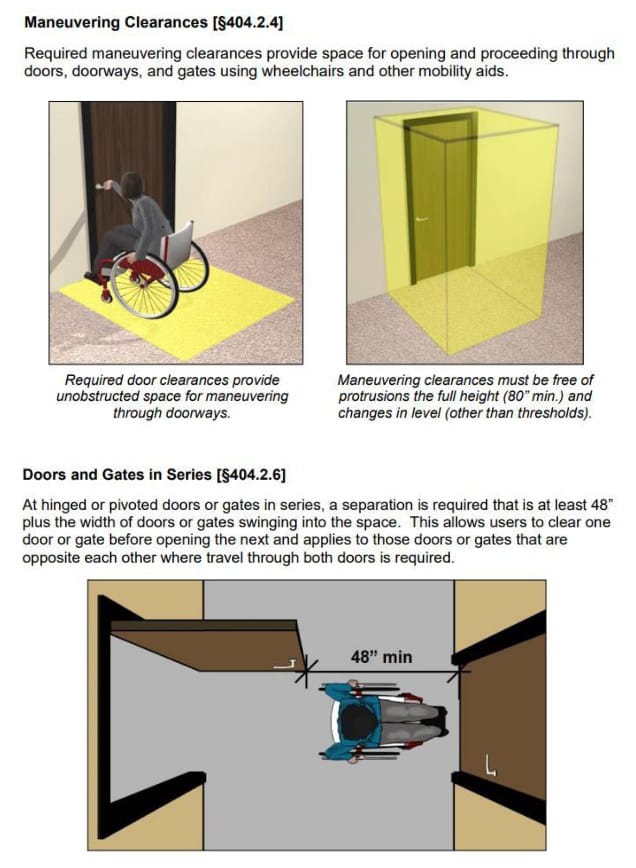
Id. at 7, 9.
This manifest purpose is a key interpretive tool. See Kisor, 588 U.S. at 575. Mandating compliance with all of § 404’s requirements imposes a lot of cost for little point if people using wheelchairs or walkers could not reach the door in the first place. But the regulations make perfect sense if a § 404-compliant door is “part of an accessible route,” as § 404.1 indeed says, with a ramp that accommodates those using wheelchairs or walkers. My reading, therefore, effectuates a “principal purpose” of § 206.4.1 and § 404, which weighs in favor of interpreting the 60% Rule to require accessible routes. See Abramski, 573 U.S. at 181 (citation omitted); see also Scalia & Garner, Reading Law 20.
For these reasons, in my view the ADA’s 60% Rule requires the second entrance to Crue Hair to be ramped. And I would hold that the district court erred by granting summary judgment to HSD.
II. Majority Opinion
The majority opinion, by contrast, concludes that the 60% Rule has nothing to do with whether individuals with disabilities can actually access doorways and instead is about only the technical specifications of doorways under § 404. And its interpretation has enormously consequential results. The majority opinion acknowledges that it “remove[s] a minimum threshold” for accessible entrances, Maj. Op. at 19, by erasing any proportionality requirement for how many public entrances must be accessible to those who cannot climb stairs. That result is a sea change, as under the majority opinion’s logic the 1991 Standards’ 50% protection also no longer applies. See Colo. Cross Disability Coal., 765 F.3d at 1218 (citing 28 C.F.R. § 36.211(c)). Accordingly, the majority opinion removes a core protection that has consistently, from enactment until now, been a key protection of the Title III accessibility standards.
The majority opinion reaches this result even though the traditional tools of regulatory interpretation—text, structure, drafting history, and purpose—do not compel its conclusion. What’s more, its interpretation creates illogical results. Indeed, the results of the majority opinion’s interpretation make so little sense that even HSD’s counsel abandoned the majority opinion’s view. At oral argument, HSD’s counsel conceded that “60% [of public entrances] have to have ramps.” Oral Arg. at 29:42.3. Instead of defending the majority opinion’s interpretation, HSD took the position at oral argument that the 60% Rule applies to the entrances to the multi-unit building as a whole as opposed to Crue Hair’s entrances specifically. Oral Arg. at 29:48. As the majority opinion explains, this argument is incorrect, because the 60% Rule applies to each place of public accommodation (such as Crue Hair). Maj. Op. at 8; see also 28 C.F.R. § 36.102. The majority opinion errs by reaching a contrary conclusion.
In my view, the majority opinion commits two main missteps. First, its textual analysis misunderstands the regulations. Second, its interpretation misconstrues the regulations’ history and contravenes their purpose.
A. Textual Problems
The majority opinion’s primary textual analysis consists of faulting § 206.4.1 for not repeating § 206.4’s requirement that covered entrances be on an accessible route. But, as I have explained, § 206.4 is the general provision, and its requirements apply to all its subsections, including § 206.4.1 (the 60% Rule). Therefore, the subsection containing the 60% Rule did not need to repeat the accessible route requirement. See Williams, 44 F.4th at 128. As noted above, my interpretation is the only one that gives force to both § 206.4 and its subsections.
The majority opinion effectively concedes that its interpretation gives no force to § 206.4, the general provision. See Maj. Op. at 15. That interpretation therefore runs afoul of the “cardinal principle” that we should give effect to as much of the text as possible. Parker Drilling, 587 U.S. at 611 (quoting Loughrin, 573 U.S. at 358). Rather than adopt an interpretation that gives meaning to § 206.4, the majority opinion says that, on my reading, that general provision would “swallow up” other, more specific provisions, including § 206.2 and § 206.4.1. Maj. Op. at 13. But that’s not right. As described above, on my interpretation, § 206.4 establishes what its subsections do; its subsections define the numbers of particular types of entrances governed by § 206.4; and § 206.2 sets a floor for sites not covered by § 206.4 and its subsections. Therefore, on my reading of the regulations—but not the majority opinion’s—each provision has effect.
The majority opinion’s negative implication argument fails for the same reason. The majority opinion says the fact that § 206.4, but not the 60% Rule, refers to “accessible route[s] complying with [§] 402” means that the 60% Rule was not meant to require accessible routes. Maj. Op. at 15. But if the absence of that reference from the 60% Rule is meaningful, then so must be the presence of that reference in § 206.4. And yet the majority opinion effectively reads that reference out of the regulations.4. Moreover, the negative implication canon itself cuts against the majority opinion’s interpretation. As noted above, see supra at 30, § 206.4.5, like § 206.4.1, states that tenant spaces must “comply with [§] 404.” 36 C.F.R. pt. 1191, app. B § 206.4.5. But it also includes an exception providing that one type of tenant space (certain self-service storage facilities) “shall not be required to be on an accessible route.” Id. This limited exception thus “implies the exclusion of other[]” exceptions—in other words, that facilities beyond the scope of the exception are required to be on an accessible route. Cf. Maj. Op. at 15; see also, e.g., Travelers Indem. Co. v. Bailey, 557 U.S. 137, 150 (2009). That requirement, as I have explained, stems from § 206.4’s general provision. And because the 60% Rule is covered by that general provision—but has no exception like 206.4.5—60% of public entrances are required to be on an accessible route. I would not read an extra exception into the regulations as the majority does.
Not only does the majority opinion’s textual interpretation create surplusage, but it overreads a minor change in the regulations to nullify an essential requirement of the scheme. The majority opinion contends that when promulgating the 2010 Standards, the Access Board and DOJ surreptitiously eliminated the proportionality requirement for accessible entrances—even as they stated that they were increasing that requirement. See ADA Accessibility Guidelines for Buildings and Facilities, 69 Fed. Reg. 44084, 44093–94 (July 23, 2004). When increasing the percentage of public entrances covered by the Rule from 50 to 60, we are told, the regulations simultaneously deleted a core ADA protection that has existed for the past thirty years. Maj. Op. at 16–18. And the 50% proportionality requirement from the 1991 Standards doesn’t revive either. See Colo. Cross Disability Coal., 765 F.3d at 1218 (citing 28 C.F.R. § 36.211(c)). Instead, according to the majority opinion, the ADA regulations require only one accessible route connecting every space across an entire site. See supra at 30–32. I do not think the 2010 Standards hid such a fundamental alteration of the regulatory scheme in a rewording of the proportionality requirement. See Whitman, 531 U.S. at 468.
Nonetheless, the majority opinion’s final textual argument invokes the “elephants in mouseholes” canon. The majority opinion says that the 60% Rule requiring ramps is a “significant burden” such that the text of the regulations needed to be clearer than it already is. See Maj. Op. at 16. But the majority opinion gets this canon backwards. To be sure, the 60% Rule means that for a public accommodation with two public entrances, like Crue Hair, both must be accessible. But, for several reasons, that requirement is not a significant and novel burden that weighs in favor of the majority opinion’s interpretation.
First, the regulations apply to a limited swathe of buildings. For instance, the regulations apply only to new and newly altered buildings. 36 C.F.R. pt. 1191, app. B § 201.1. So grandfathered-in older buildings face no compliance costs from the 60% Rule. As another example, as noted, the 60% Rule applies only to public entrances, so it isn’t the case that 60% of all entrances have to include ramps. Many buildings that have two entrances, as the majority opinions references, have only one covered public entrance, as employee and service entrances do not count for the 60% Rule. Second, the DOJ Guidance clarifies that the increase from 50% to 60% in the 2010 Standards was “not expected to result in a substantial increase in the number of accessible entrances.” 28 C.F.R. pt. 36, app. B. That’s because many building codes, which the ADA supplements, already required more than one accessible entrance. See id. Indeed, the facts of this case show that building two ramped entrances is not a huge or unexpected burden. The architect of HSD’s facility designed Crue Hair with two accessible entrances, including a ramp to its front entrance. He even testified that he “would not have approved” stairs at Crue Hair’s street- facing entrance. Architect Decl., R. 50-3, PageID 253.5. The record is not clear why the building plans for HSD’s facility were ultimately altered and the ramp at Crue Hair’s street-facing entrance replaced with stairs. Third, the amendments to the ADA regulations that led to the 60% Rule were more even-handed than the majority opinion portrays. Even as the 2010 Standards bumped the proportion of accessible public entrances from 50% to 60%, they helped building owners and constructors in other ways. For example, the 2010 Standards eased compliance requirements on buildings and constructors by simplifying several other requirements regarding public entrances. Colo. Cross Disability Coal., 765 F.3d at 1223–24.
The upshot of all of this? The 60% Rule is not the “significant burden” that the majority contends, so the majority opinion errs by demanding even clearer textual proof that the 60% Rule requires accessible routes. Conversely, as noted, it is the majority opinion’s dramatic deletion of a key ADA protection that has existed for decades that reads transformative meaning into a minor change.
B. Contravening History and Purpose
In addition to misreading the text, in my view the majority opinion errs in its analysis of the 60% Rule’s drafting history and purpose. As to the drafting history, the majority opinion focuses entirely on the fact that the 1991 Standards said “50% of public entrances . . . must be accessible” while § 206.4.1 explicitly references only § 404. Relying on the canon that a “significant change in language is presumed to entail a change in meaning,” it contends that this change in language proves its interpretation correct. Maj. Op. at 16 (quoting In re Davis, 960 F.3d 346, 354 (6th Cir. 2020)).
For two reasons, however, I disagree that the drafting history does the work that the majority opinion needs it to. First, the majority opinion’s read of the drafting history is unresponsive to the fact that the 2010 Standards simply incorporate the accessible route requirement in § 206.4 (the general provision), which governs § 206.4.1 (the subsection). Second, the presumption that a change in language entails a change in meaning is just that: a presumption. Here, the fact that all contemporaneous evidence of intent directly contradicts the way the majority opinion uses this canon overcomes any presumption. In fact, the notice and comment rulemaking for the 2010 Standards rejected the interpretation the majority opinion adopts today. It expressly stated that the “minimum number of entrances required to be accessible has been increased from 50% to 60%”—indicating that the change in language was not intended to effect a change in meaning, beyond increasing the percentage. See ADA Accessibility Guidelines for Buildings and Facilities, 69 Fed. Reg. at 44093–94. Accordingly, I find the majority opinion’s reliance on the drafting history unpersuasive.
The majority opinion’s interpretation also contravenes the 2010 Standards’ purpose. The majority opinion recognizes, as it must, that the “purpose of a regulation” is an important interpretive tool. Maj. Op. at 19 (quoting Kisor, 588 U.S. at 575). Yet it has no persuasive response to the point that it serves very little purpose for the 60% Rule to require compliance with § 404’s myriad technical requirements for doors if the rule does not also require accessible routes with ramps. The majority opinion contends that requiring 60% of public entrances to comply with § 404, even though the entrances have stairs, still “greatly expands” accessibility, although it acknowledges that its approach regrettably “does not reach individuals with,” in the majority opinion’s characterization, “the most debilitating physical disabilities.” Id. at 16.
But characterizing people who cannot climb stairs as a fringe proportion of individuals with disabilities ignores reality. An inability to climb stairs is one of the most common, if not the most common, mobility limitation. Indeed, “nearly one in eight American adults cannot manage to go up and down stairs.” Ellison v. U.S. Postal Serv., 84 F.4th 750, 761 (7th Cir. 2023) (Hamilton, J., concurring). And almost half of Americans with disabilities use some form of mobility aid that makes stairs difficult or inaccessible. U.S. Dep’t of Transp., Bur. of Transp. Stats., Travel Patterns of Adults with Travel-Limiting Disabilities 4 (2024), perma.cc/4Z8V-L76L.
Considering these facts, I fail to see how requiring 60% of public entrances to comply with § 404, yet allowing almost all those entrances to have stairs, “greatly expands” accessibility. Cf. Maj. Op. at 20. While there are perhaps some people who can climb stairs and would benefit from § 404’s requirements even without an accessible route, the majority opinion does not even attempt to identify who is in that small group of people. And do § 404’s requirements of low handles, five- foot-wide maneuvering platforms, and the like even help those people? The majority opinion’s assumption that they do is pure speculation.6. At oral argument, I asked HSD’s counsel what purpose, if any, the 60% Rule serves if it does not require accessible routes, including ramps for wheelchairs. HSD’s counsel contended that having wide doorframes and maneuvering platforms—even if they could only be reached by stairs— would benefit people with luggage. Oral Arg. at 27:05. Given that the ADA is an antidiscrimination statute, PGA Tour, Inc. v. Martin, 532 U.S. 661, 674–75 (2001), I do not think making it easier to carry luggage effectuates the purpose of the ADA regulations. The fact that neither counsel nor the majority opinion can identify the target group for the 60% Rule as the majority opinion construes it reenforces my view that its interpretation makes no sense. And I would not interpret the 60% Rule to impose costs on builders to comply with § 404’s various physical requirements if it is unclear who, if anyone, would benefit.
Indeed, on the majority opinion’s reading, because the 60% Rule never requires accessible routes and has no bearing on the path leading up to the door, public accommodations could satisfy the 60% Rule by creating entrances that are, in fact, entirely inaccessible. Take one example. What if a public accommodation had a door on a balcony that could only be accessed by climbing a rope ladder? In the majority opinion’s view, that’s good enough for the 60% Rule—as long as the balcony itself is spacious enough for a wheelchair under § 404.2.4. Such “illogical results” weigh in favor of my interpretation of the 60% Rule. See W. Air Lines, Inc. v. Bd. of Equalization of S.D., 480 U.S. 123, 133 (1987); see also Kirtsaeng v. John Wiley & Sons, Inc., 568 U.S. 519, 544–45 (2013).
Ultimately, though, I do not need to resort to hypotheticals. The 60% Rule’s purpose—to increase accessibility for those who use wheelchairs and mobility aids—is plain. And given the prevalence of individuals who have difficulty climbing stairs, I would decline to adopt an interpretation of the 60% Rule that depends on dismissing that group of people as those with “the most debilitating physical disabilities.” Cf. Maj. Op. at 20. Instead, I would interpret the 60% Rule in a manner that effectuates the primary purpose of § 206.4 and § 404, and is the best reading of the text, structure, and drafting history.
CONCLUSION
The 60% Rule requires a ramp at Crue Hair’s second public entrance. Because the majority opinion holds otherwise, I respectfully dissent from the majority opinion’s affirmance as to HSD.