NOT RECOMMENDED FOR PUBLICATION
UNITED STATES COURT OF APPEALS FOR THE SIXTH CIRCUIT
3371 Reading, LLC v. Liberty Mutual Group, Inc.
Southern District of Ohio at Cincinnati
BeforeBUSH, READLER, and DAVIS, Circuit Judges.
BUSH, J., delivered the opinion of the court in which DAVIS, J., joined. READLER, J. (pp. 14–23), delivered a separate opinion concurring in part and dissenting in part.
View the official PDF → · unofficial reading copy; the court’s PDF controls
JOHN K. BUSH, Circuit Judge. Plaintiff-Appellant 3371 Reading owned a building undergoing renovation in Cincinnati. After the structure burned down, 3371 Reading made a claim on its insurance policy. Defendant-Appellee Ohio Casualty denied coverage because 3371 Reading failed to build a fence around its property, which was a construction job site.
3371 Reading sued for breach of contract, bad faith, fraud in the inducement, and a violation of the Ohio Deceptive Trade Practices Act (ODTPA), Ohio Rev. Code §§ 4165.01 to 4165.04. The district court granted summary judgment to defendants-appellees on all claims. We REVERSE as to the contract claim, AFFIRM as to the other three claims, and REMAND for further proceedings.
I.
The property where the fire occurred has an unusual design. As shown below, it is shaped like a trapezoid, with Reading Road abutting the property to the east and land owned by the Urban League abutting it to the north. A real estate development abuts the property to the west, and on the south side, a neighboring building shared a wall with the structure destroyed in the blaze.
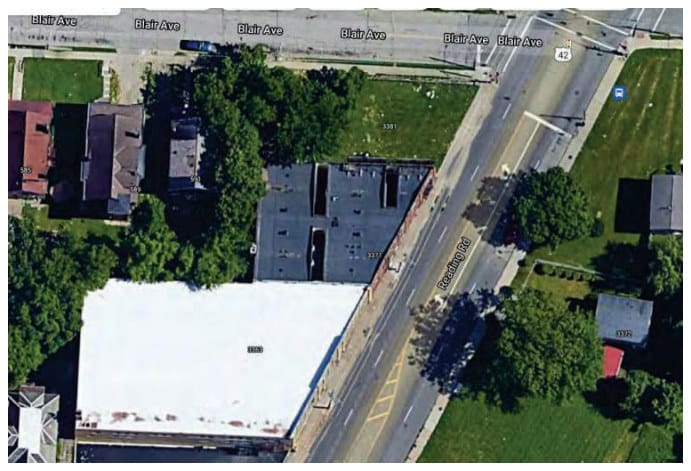
R. 49-4, Jones Dep., Exh. A, pt. 4, PageID 1008.
The fire occurred during renovations to the building, requiring it to be torn down. The cause of the fire remains unknown.
In denying 3371 Reading’s insurance claim, Ohio Casualty stated that “[n]o fencing was placed around the jobsite as required by the Protective Devices Endorsement [(PDE)] on the policy.” R. 52-2, Denial of Coverage Letter, PageID 2775. Fencing was relevant because the PDE requires a “Fenced Jobsite” for all “locations specified in the” Protective Devices Schedule (PDS) and schedule of coverages. R. 76-1, Insurance Policy, PageID 3761–62. “Fenced Jobsite” means “a fence, not less than six (6) feet in height, that completely surrounds the jobsite, with no openings unless gated. All gates to such fence shall be closed and locked, to secure against entry to the jobsite, during all non-working hours.” Id. at PageID 3761.
But building a fence around the perimeter of the entire property was impossible. There is no space on 3371 Reading’s side of the property line to place a fence on the north, east, and west sides of the property, so erecting a fence would have required 3371 Reading to either trespass on its neighbors’ properties or obtain easements from them. More importantly, the property and its southern neighbor share a wall, so the most that 3371 Reading could have done was build a fence along three sides of the property, as defendants-appellees helpfully diagrammed in their brief:
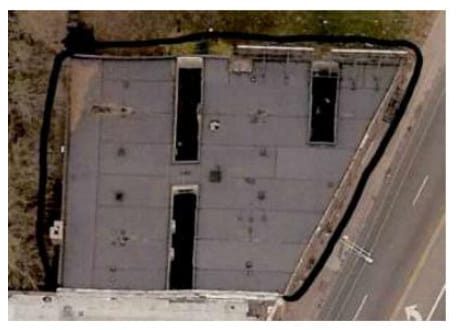
Appellees’ Br. at 16–17.
3371 Reading sued over the coverage decision in Ohio state court, and the case was removed based on diversity jurisdiction.1. We were concerned that the parties might not have been completely diverse, so we asked for letters addressing the parties’ citizenship. See, e.g., Taylor v. Owens, 990 F.3d 493, 496 (6th Cir. 2021). We now know that 3371 Reading’s members are Israeli citizens living in the United States on non-immigrant visas, so 3371 Reading is a citizen of Israel. See V & M Star, LP v. Centimark Corp., 596 F.3d 354, 356 (6th Cir. 2010). Defendant-Appellee Liberty Mutual is incorporated in Massachusetts, Ohio Casualty is incorporated in New Hampshire, and both have their principal place of business in Massachusetts. Consequently, Liberty Mutual is a citizen of Massachusetts, and Ohio Casualty is a citizen of both Massachusetts and New Hampshire. See 28 U.S.C. § 1332(c)(1). Defendant-Appellee Jonathan Jones, the agent who wrote the policy at issue, lives in Colorado. Because there are foreign citizens on one side of the dispute and American citizens on the other, and because none of the foreign citizens are lawful permanent residents, the district court had jurisdiction under 28 U.S.C. § 1332(a)(2). After discovery, all defendants-appellees moved for summary judgment, and 3371 Reading cross-moved for partial summary judgment. The district court sided with defendants-appellees, and this timely appeal followed.
II.
A.
The district court’s summary judgment ruling, its interpretation of state law, and its interpretation of the insurance policy are all questions of law that we review de novo. See, e.g., Home Depot, Inc. v. Steadfast Ins. Co., 125 F.4th 769, 774 (6th Cir. 2025); Sault Ste. Marie Tribe of Chippewa Indians v. Engler, 146 F.3d 367, 373 (6th Cir. 1998). “Summary judgment is proper where no genuine issue of material fact exists and the moving party is entitled to judgment as a matter of law.” Hunt v. Sycamore Cmty. Sch. Dist. Bd. of Educ., 542 F.3d 529, 534 (6th Cir. 2008). We take the facts in the light most favorable to the non-moving party, giving it the benefit of all reasonable inferences. Craig v. Bridges Bros. Trucking LLC, 823 F.3d 382, 387 (6th Cir. 2016).
B.
3371 Reading mainly claims that Ohio Casualty and Liberty Mutual breached the insurance policy and acted in bad faith when Ohio Casualty denied coverage. We agree on the first point but not the second one.
Insurance policies are a specialized type of contract, so courts interpreting them “must give effect to the intent of the parties” as “reflected in the plain and ordinary meaning of the contract language.” Smith v. Erie Ins. Co., 69 N.E.3d 711, 715 (Ohio 2016) (quoting Granger v. Auto- Owners Ins., 40 N.E.3d 1110, 1115 (Ohio 2015)). “[P]rovisions in an insurance contract that are reasonably susceptible of more than one interpretation will be construed liberally in favor of the insured.” Laboy v. Grange Indem. Ins. Co., 41 N.E.3d 1224, 1227 (Ohio 2015). But when an insurance policy is unambiguous, we must apply it as written in light of the other rules of Ohio insurance law. See Grange Indem. Ins. Co. v. Hinds, 228 N.E.3d 714, 718 (Ohio Ct. App. 2023).
When we read an Ohio insurance policy, we do so “from the standpoint of a layman, not a lawyer,” and ask how “a reasonably prudent person applying for insurance would have” interpreted the policy. Bluemile, Inc. v. Atlas Indus. Contractors, Ltd., 102 N.E.3d 579, 584 (Ohio Ct. App. 2017) (quoting Snedegar v. Midwestern Indem. Co., 582 N.E.2d 617, 619–20 (Ohio Ct. App. 1989)). The insurer must prove that its interpretation “is the only one that can fairly be placed on the language in question.” Andersen v. Highland House Co., 757 N.E.2d 329, 332 (Ohio 2001) (quoting Thomas M. Reiter, David J. Strasser & William J. Pohlman, The Pollution Exclusion Under Ohio Law: Staying the Course, 59 U. Cin. L. Rev. 1165, 1179 (1991)).
“[I]f a strict grammatical reading of the language results in unnecessary or superfluous terms, then such an interpretation is not reasonable.” Garlock v. Jordan, 260 N.E.3d 42, 47 (Ohio Ct. App. 2025). Similarly, courts avoid interpreting insurance policies in ways that render them illusory. Talbert v. Cont’l Cas. Co., 811 N.E.2d 1169, 1172 (Ohio Ct. App. 2004). An insurance policy is illusory when it is impossible to comply with one or more of the preconditions to coverage. See id. “If a provision renders the policy illusory, then the provision is unenforceable.” Collins v. Auto-Owners Ins. Co., 80 N.E.3d 542, 551 (Ohio Ct. App. 2017).
With these guiding principles in mind, we return to the policy language. Recall that the PDE requires a “Fenced Jobsite” as a purported precondition to coverage for all “locations specified in the” PDS and schedule of coverages. R. 76-1, Insurance Policy, PageID 3761–62.2. The parties dispute whether (and the dissent asserts that) the PDS applies to 3371 Reading’s property because the schedule of coverages has 3371 Reading’s address on it, but the PDS does not. We need not resolve that dispute, however, because even assuming the policy’s terms impose a fencing requirement on the property, that requirement is unenforceable. We predict that, if faced with the same question, the Ohio courts would not have enforced the PDS. See Beverage Distributors, Inc. v. Miller Brewing Co., 690 F.3d 788, 792 (6th Cir. 2012) (“If the Ohio Supreme Court has not yet addressed the issue presented, this Court must predict how it would rule, by looking to all relevant data, including state appellate decisions.” (cleaned up)). That means the PDS is not enforceable, and 3371 Reading was entitled to coverage.
Building a fence around the entire property was impossible because the property shared a wall with its southern neighbor—a point that defendants-appellees expressly conceded when they stated in their brief (and provided a diagram showing) that the fence could be built only around three sides of the property. That means it would have been impossible to comply with the purported precondition to coverage of a fence “that completely surrounds the jobsite . . . .” R. 76-1, Insurance Policy, PageID 3761 (emphasis added). Thus, even if the policy were read to require the type of fencing stated in the policy, that requirement is void with respect to the property at issue because of impossibility of performance. See Collins, 80 N.E.3d at 551.
We are not “artificially putting [our] thumb on the scale” in 3371 Reading’s favor, nor are we “putting” the fencing provision “in [its] grave . . . .” Dissent at 16, 19. We do not and need not hold that there is no fencing requirement in the policy. We are simply assuming that there is and then holding that it is unenforceable because performance was impossible.
The dissent also takes issue with our holding because there was no “interceding, unforeseen event” that “render[ed] performance impossible,” Dissent at 17, but the dissent’s interpretation of Ohio law renders it internally inconsistent. In Ohio, insurance policies must grant coverage in at least one circumstance. See Raudins v. Hobbs, 104 N.E.3d 1040, 1056 (Ohio Ct. App. 2018). If we were to apply the unforeseen circumstances rule to this case, then we would be interpreting the policy to never provide coverage because the shared wall makes it impossible to build a fence around all four sides of the building, and the fence is listed in the policy as a mandatory precondition to coverage. The only way to harmonize these two rules of law is to hold that the unforeseen circumstances rule does not apply to an insurance contract like the one at issue here. Indeed, perhaps that is why we have not found an Ohio insurance case that applies the impossibility rule in the way the dissent proposes and why none of the cases cited by the dissent are insurance cases. See London & Lancashire Indem. Co. of Am. v. Bd. of Comm’rs of Columbiana Cnty., 140 N.E. 672, 673 (Ohio 1923) (construction contract); Skilton v. Perry Loc. Sch. Dist. Bd. of Educ., No. 2001-L-140, 2002 WL 31744700, at *1 (Ohio Ct. App. Dec. 6, 2002) (employment contract), aff’d, 807 N.E.2d 919 (Ohio 2004); J.I.L. One, LLC v. Kemper, No. C-130555, 2014 WL 5794607, at *1 (Ohio Ct. App. Nov. 7, 2014) (land contract); Starlion Elecs. Distrib., LLC v. Zoran Med., LLC, 223 N.E.3d 780, 783 (Ohio 2023) (settlement agreement); Univ. Sch. v. M.F., 262 N.E.3d 504, 505 (Ohio Ct. App. 2025) (private school enrollment contracts).
We respectfully disagree with the dissent’s assertion that performance was not impossible because a three-sided fence would have “enclose[d] any area where construction work was occurring” as matter of both fact and law. Dissent at 18.
As a factual matter, the fourth wall, the one that is shared with the property’s southern neighbor, would not have been “completely cut[] off . . . from public access” because the public would have had access to the fourth wall by going inside the neighboring building. Id. Thus, under the rule the dissent devises to avoid the impossibility problem, performance still would have been impossible.
As a legal matter, the dissent’s attempt to avoid the impossibility problem violates several rules of insurance policy interpretation. First, canons of construction, like interpreting the policy to avoid rendering it illusory, apply only when the policy is ambiguous. See Ledyard v. Auto-Owners Mut. Ins. Co., 739 N.E.2d 1, 3–4 (Ohio Ct. App. 2000); Talbert, 811 N.E.2d at 1172. And as the dissent recognizes (at 16), if the policy is ambiguous, we must interpret it in the policyholder’s favor. See, e.g., Laboy, 41 N.E.3d at 1227. The fact that we are even questioning whether the policy is illusory therefore means we must side with the policyholder. Second, and relatedly, a canon of construction cannot be used to avoid the plain meaning of the policy. Collins v. Auto-Owners Ins. Co., 80 N.E.3d 542, 547 (Ohio Ct. App. 2017). And here, a fence completely surrounding the property3. The dissent is incorrect to suggest (at 19–20) that there is any daylight between the terms “jobsite” and “property” because the term “jobsite” in the policy “means any location, project, or work site where” the policyholder is “in the process of renovating or rehabilitating a building or structure.” R. 76-1, Insurance Policy, PageID 3812. Since the building here is the entire property, the building (or its remains post-demolition) needed to be surrounded on all four sides. Even if it was possible to obtain easements on the adjacent properties to build fencing along three sides of the building, fencing on the fourth side would have required tearing down the structure abutting the building on the fourth side. This fourth-side teardown could not occur because someone else owned the property where the teardown would have occurred. Hence, compliance with the fencing provision was impossible, regardless of the measures 3371 Reading could have taken to overcome the impediment. means one that makes it impossible to reach the fourth wall of the property—one that all agree cannot be built.
It is no answer that the insurance companies said they would have provided coverage if 3371 Reading built the fence along three sides of the property. See id. (“[W]e . . . ‘presume that the intent of the parties is reflected in the language used in the policy.’” (citation omitted)). The meaning of an insurance policy is a question of law for the court to decide, Acuity v. Masters Pharm., Inc., 205 N.E.3d 460, 465 (Ohio 2022), not one for the insurance company’s lawyers to devise post hoc when defending a lawsuit, cf. Motor Vehicle Mfrs. Ass’n of the U.S., Inc. v. State Farm Mut. Auto. Ins. Co., 463 U.S. 29, 50 (1983) (“[T]he courts may not accept appellate counsel’s post hoc rationalizations for agency action.”). And an independent review of the policy makes clear that the fencing provision requires a fence that prevents access to any portion of the property, including the shared wall on the property’s southern boundary. As everyone acknowledges, building that fence is impossible.
Nor is it an answer to say that a party cannot assert impossibility of performance without using “reasonable efforts to surmount obstacles to performance . . . .” Dissent at 19 (quoting W. Rsrv. Acad. v. Franklin, 999 N.E.2d 1198, 1202 (Ohio Ct. App. 2013)). That might undermine impossibility based on a legal impediment to performance because Ohio law generally requires contracting parties to get regulatory variances before a legal impediment to performance can render a contract impossible to perform. See Mt. Pleasant Blacktopping Co. v. Inverness Grp., Inc., 262 N.E.3d 1180, 1196 (Ohio Ct. App. 2025) (“[T]he party claiming excuse” must “attempt[] in good faith to comply with or avoid the application of the relevant regulation.”), appeal not allowed, 265 N.E.3d 59 (Ohio 2025). But the impediment here is physical—the inability to build a fence that would prevent access to the southern wall. Unless the dissent believes that 3371 Reading should have torn down the building next to it to build a fence, we struggle to see what efforts could have been undertaken to overcome that obstacle to performance.4. This does not mean, of course, that only legal impediments to performance are subject to this rule. Rather, the efforts undertaken need only be reasonable, see W. Rsrv. Acad. v. Franklin, 999 N.E.2d 1198, 1202 (Ohio Ct. App. 2013), and we do not find it reasonable for 3371 Reading to try to surmount the obstacle to performance here because it is physically impossible to overcome it. Building the fence around three walls would not have worked because, as we noted above, that would not have complied with the terms of the policy.
We therefore conclude that 3371 Reading was entitled to coverage for the fire.5. The district court did not address whether Liberty Mutual was in privity of contract with 3371 Reading or whether 3371 Reading was entitled to the full value of the policy because its summary judgment ruling mooted those issues. We will let the district court address them in the first instance on remand.
That said, we see no evidence suggesting that Ohio Casualty and Liberty Mutual acted in bad faith. “[B]ad faith is not shown by a mere breach of a contractual duty, nor can it be shown by an insurance company’s mistaken actions relating to an unclear contractual provision.” Ohio Bar Liab. Ins. Co. v. Hunt, 787 N.E.2d 82, 89 (Ohio Ct. App. 2003). This policy was difficult to parse, and the insurance companies’ position was at least plausible. Additionally, an insurer’s intent in drafting the policy (or even in deciding whether to accept or deny the claim) is irrelevant. See Zoppo v. Homestead Ins. Co., 644 N.E.2d 397, 400 (Ohio 1994). What matters is that the insurance policy was unclear, and Ohio law thus precludes a finding of bad faith.
We therefore reverse the breach of contract ruling but affirm the bad faith ruling.
C.
3371 Reading also alleges that all three defendants-appellees fraudulently induced it to buy the policy and that the insurance companies violated the ODTPA. We disagree.
Fraudulent inducement. Ohio law bars fraudulent inducement claims based “on predictions or projections relating to future performance” of a contract. Lucarell v. Nationwide Mut. Ins. Co., 97 N.E.3d 458, 472–73 (Ohio 2018). That is exactly what 3371 Reading claims here. It cites several statements that it claims are misrepresentations, but they all focus on what “the Policy was going to provide”—namely, coverage for loss through a fire, Appellant’s Br. at 53, 55–56—not any statement promising something other than performance of the contract. That type of claim—non-performance of a contract—of course sounds in contract, not a tort like fraudulent inducement. See Dayton Children’s Hosp. v. Garrett Day, LLC, 149 N.E.3d 1004, 1031–32 (Ohio 2019).
Perhaps sensing this problem, 3371 Reading alleges that defendants made “a promise of future action, occurrence, or conduct” with “no concurrent intention of keeping it.” Harris v. Sunsong Holdings, Inc., 169 N.E.3d 1030, 1037 (Ohio Ct. App. 2021) (quoting Martin v. Ohio State Univ. Found., 742 N.E.2d 1198, 1205 (Ohio Ct. App. 2000)) (cleaned up). 3371 Reading, however, cites no evidence of a concurrent intention of refusing to ever provide coverage. Jones did admit that he failed to do his due diligence in writing the policy, but the absence of due diligence is negligence, not fraud. See Textron Fin. Corp. v. Nationwide Mut. Ins. Co., 684 N.E.2d 1261, 1269 (Ohio Ct. App. 1996) (“inadvertence” and “the failure to exercise reasonable care” are not fraud (quoting Tighe v. Diamond, 80 N.E.2d 122, 126 (Ohio 1948))). And the only other testimony that 3371 Reading relies on is Jones saying “that Ohio Casualty will never pay for a fire loss if the insured fails to maintain” a fence “completely surrounding the” property. R. 49, Jones Dep., PageID 504 (cited in Appellant’s Br. at 52). That says nothing about what he intended when he wrote the policy.
We do not think that 3371 Reading can prove scienter, either. See Doyle v. Fairfield Mach. Co., 697 N.E.2d 667, 676–77 (Ohio Ct. App. 1997). The policy was confusing, and if more had been done to proofread the policy, the insurance companies may have found the mistake that leads us to our decision on coverage. But this is, at most, mere negligence. And to reiterate, negligence is not fraud. See Textron Fin. Corp., 684 N.E.2d at 1269.
Fraud under the ODTPA. Under the ODTPA, a seller “engages in a deceptive trade practice when” it “[r]epresents that goods or services have sponsorship, approval, characteristics, ingredients, uses, benefits, or quantities that they do not have.” Ohio Rev. Code § 4165.02(A)(7). The ODTPA “generally regulates trademarks, unfair competition, and false advertising.” Dawson v. Blockbuster, Inc., No. 86451, 2006 WL 1061769, at *3 (Ohio Ct. App. Mar. 16, 2006). In other words, a traditional ODTPA claim is not normally a consumer fraud claim.
That dooms the ODTPA claim. 3371 Reading does not allege that Ohio Casualty or Liberty Mutual made a false statement in an advertisement or marketing literature. See Heartland of Urbana OH, L.L.C. v. McHugh Fuller L. Grp., P.L.L.C., 72 N.E.3d 23, 38 (Ohio 2016); Spafford v. Cuyahoga Cmty. Coll., No. 84786, 2005 WL 797936, at *3–4 (Ohio Ct. App. Apr. 7, 2005). 3371 Reading similarly does not allege that the insurance companies are operating under its name or otherwise using its trademarks and trade dress. See Cesare v. Work, 520 N.E.2d 586, 589 (Ohio Ct. App. 1987); George P. Ballas Buick GMC, Inc. v. Taylor Buick, Inc, No. 81-292, 1982 WL 6359, at *4–5 (Ohio Ct. App. Apr. 16, 1982). Instead, 3371 Reading alleges that it was induced to buy a product it would not have bought because Ohio Casualty and Liberty Mutual lied when 3371 Reading was procuring the policy. That is a consumer fraud claim, not an unfair competition claim. The ODTPA therefore does not provide a vehicle for relief.
And that makes sense. Consumers do not have statutory standing under the ODTPA, Hamilton v. Bell, 7 N.E.3d 1241, 1253 (Ohio Ct. App. 2014), so it would be odd to say that the ODTPA provides redress for consumer fraud. Moreover, the Ohio Consumer Sales Practices Act (OCSPA) is “[t]he proper remedy for consumers seeking redress against unfair, deceptive, or unconscionable acts in the sale of consumer goods or services”—i.e., consumer fraud. Id. Under Ohio’s rules of statutory interpretation, we therefore must presume that the OCSPA covers consumer fraud while the ODTPA covers something else. See New Riegel Loc. Sch. Dist. Bd. of Educ. v. Buehrer Grp. Architecture & Eng’g, Inc., 133 N.E.3d 482, 492 (Ohio 2019).
In short, 3371 Reading invokes the wrong vehicle for relief. The ODTPA ruling is affirmed.
III.
For these reasons, we AFFIRM in part, REVERSE in part, and REMAND for further proceedings not inconsistent with this opinion.
READLER, Circuit Judge, concurring in part and dissenting in part. A fire of unknown origin destroyed the building located at 3371 Reading Road in Cincinnati. The building’s owner, 3371 Reading, LLC (Reading), sought coverage for the damage from its insurer, Ohio Casualty Insurance Company. Ohio Casualty denied coverage on the grounds that Reading breached the fencing provision in the insurance policy, which required Reading to erect a fence enclosing the building’s “jobsite” to cut off any public access. Ohio Casualty understood the fencing provision to be a condition precedent for fire coverage. And in light of Reading’s failure to satisfy that requirement, Ohio Casualty refused to perform on the policy. I agree with the district court that Ohio Casualty was legally authorized to do so and, as a result, was entitled to judgment in its favor on all claims, not just those claims rejected in the majority opinion.
By way of background, the parties entered their contractual relationship with the understanding that Reading intended to “rehab the building” at 3371 Reading Road “into 18 apartment units and two storefronts.” Appellant Br. 7. The building, which had recently received a Notice of Violation from the City of Cincinnati given its “state of disrepair” and “vandalized dilapidated structure open to trespassers,” R. 94-2, PageID 4701, was located in a high-crime area. Accordingly, the policy Ohio Casualty issued to Reading included a provision that required Reading to “maintain, at all times during the policy period, the protective devices and services described on the Protective Devices Schedule” included in the policy. Policy, R. 76-1, PageID 3762. The Protective Devices Schedule, in turn, required a “Fenced Jobsite,” which the policy defined as “a fence, not less than six (6) feet in height, that completely surrounds the jobsite, with no openings unless gated.” Id. at PageID 3761. The plain and ordinary meaning of the fencing provision thus required Reading to erect and maintain a fence around the jobsite at 3371 Reading Road. Yet Reading failed to honor that obligation—not because of any uncertainty regarding the fencing requirement but rather because Reading purportedly was unaware of the requirement altogether. In light of Reading’s breach of the fencing provision, Ohio Casualty properly denied coverage. See DN Reynoldsburg, LLC v. Maurices Inc., 225 N.E.3d 454, 463 (Ohio Ct. App. 2023) (“If the condition [precedent] is not fulfilled, the parties are excused from performing.” (citation modified)).
That straightforward understanding of the parties’ agreement honors basic principles of contract law. It gives “effect to the intent of the parties” as “reflected in the plain and ordinary meaning of the contract language.” Smith v. Erie Ins. Co., 69 N.E.3d 711, 715 (Ohio 2016) (quoting Granger v. Auto-Owners Ins., 40 N.E.3d 1110, 1115 (Ohio 2015)). In so doing, it gives meaning to all provisions in the parties’ policy agreement. Foster Wheeler Enviresponse, Inc. v. Franklin Cnty. Convention Facilities Auth., 678 N.E.2d 519, 526 (Ohio 1997) (“In the construction of a contract courts should give effect, if possible, to every provision therein contained, and if one construction of a doubtful condition written in a contract would make that condition meaningless, and it is possible to give it another construction that would give it meaning and purpose, then the latter construction must obtain.” (citation modified)); see also Order, R. 119, PageID 6349 (interpreting the policy in a way that “gives the contract vitality” (citation modified)). And it avoids construing the policy in a manner that renders the contract illusory, a virtue the majority opinion likewise acknowledges. State ex rel. Gordon v. Taylor, 79 N.E.2d 127, 132 (Ohio 1948) (“[I]f the language of a contract . . . is susceptible of two constructions, one of which will render it valid and give effect to the obligation of the parties, and the other will render it invalid and ineffectual, that [construction] which sustains its validity must be adopted.”); Lawless v. Bd. of Educ. of Lawrence Cnty. Educ. Serv. Ctr., 141 N.E.3d 267, 280 (Ohio Ct. App. 2020) (“Because illusory contracts are not enforceable, courts should interpret a contract to avoid a result which renders the contract illusory.” (citation modified)); see Maj. Op. at 5 (explaining that “courts avoid interpreting insurance policies in ways that render them illusory”).
In reaching a contrary conclusion, the majority opinion effectively reads the fencing provision out of the contract. To its mind, building a fence “completely surround[ing] the jobsite” required building a fence around all four sides of the site. Maj. Op. at 6. Yet a four-sided fence was “impossible,” we are told, because the building at 3371 Reading Road shared a wall with its neighboring structure, meaning a fence could only surround three sides of the building. Id. (deeming it impossible to build a fence that surrounds the jobsite “because the property shared a wall with its southern neighbor”). Due to the “impossibility of performance” of the fencing provision, id., the majority opinion concludes, Reading could never have satisfied its contractual obligation, rendering the policy “illusory” and the fencing provision “unenforceable,” id. at 5.
The road to that conclusion, however, requires many unusual detours. The first is the majority opinion artificially putting its thumb on Reading’s side of the scale simply because Reading is the insured party. True, Ohio courts have historically interpreted ambiguous insurance contract terms “against the insurer and in favor of the insured.” Safeco Ins. Co. of Am. v. White, 913 N.E.2d 426, 431 (Ohio 2009) (quoting Westfield Ins. Co. v. Galatis, 797 N.E.2d 1256, 1262 (Ohio 2003)). But far from a favored tack, that approach is instead a rule of last resort. The Ohio Supreme Court has utilized this interpretive canon sparingly in recent years and only in the rare case when the language at issue is truly ambiguous. See State v. Porterfield, 829 N.E.2d 690, 692 (Ohio 2005) (imposing a high bar for ambiguity and requiring courts to “objectively and thoroughly examine” a contract to “ascertain its meaning” and only find ambiguity when efforts at finding any meaning “prove[] elusive”); see also AKC, Inc. v. United Specialty Ins. Co., 187 N.E.3d 501, 503 (Ohio 2021) (giving no deference to an interpretation proffered by the insured and, instead, “apply[ing] plain and unambiguous terms in the policy as they are written”); Acuity v. Masters Pharm., Inc., 205 N.E.3d 460, 465 (Ohio 2022) (refusing to construe the insurance contract liberally in favor of the insured and explaining that terms of insurance contracts “are to be given their plain and ordinary meaning”).
In light of this jurisprudential backdrop, we should not leap to deploy the rule from the start, especially where, as here, understanding the contractual language does not “prove elusive.” Porterfield, 829 N.E.2d at 692; see also World Harvest Church v. Grange Mut. Cas. Co., 68 N.E.3d 738, 745 (Ohio 2016) (citing Westfield Ins. Co. v. Hunter, 948 N.E.2d 931, 935 (Ohio 2011)). Nor should we diverge from settled contract principles in resolving today’s case on the ground that “[i]nsurance policies” purportedly “are a specialized type of contract.” Maj. Op. at 4. All contracts are “specialized” in their own sense. That is why Ohio courts interpret insurance policies as they do any other contract, employing traditional canons of contract interpretation. See Granger, 40 N.E.3d at 1115. Our touchstone thus remains the policy terms’ plain meaning. Although the parties perhaps “could have included different or more express language in their agreement” in addressing the fencing requirement, the language that was selected is easily understood and does not require deployment of any substantive canon of construction that artificially disfavors the insurer. AKC, Inc., 187 N.E.3d at 504.
Yet even with the benefit of this unnaturally lowered bar, Reading still cannot hoist itself over top. This is true for several reasons. Start with a legal roadblock, namely, that the doctrine of impossibility of performance applies only where an interceding, unforeseen event renders performance impossible. Lond. & Lancashire Indem. Co. of Am. v. Bd. of Comm’rs, 140 N.E. 672, 676 (Ohio 1923); Skilton v. Perry Loc. Sch. Dist. Bd. of Educ., No. 2001-L-140, 2002 WL 31744700, at *5 (Ohio Ct. App. Dec. 6, 2002); cf. J.I.L. One, LLC v. Kemper, No. C-130555, 2014 WL 5794607, at *4 (Ohio Ct. App. Nov. 7, 2014) (explaining that, at a minimum, the circumstances must be “unbeknownst to either party”). The doctrine comes into play “where, after the contract is entered into, an unforeseen event arises rendering impossible the performance of one of the contracting parties.” Starlion Elecs. Distrib., LLC v. Zoran Med., LLC, 223 N.E.3d 780, 788 (Ohio Ct. App. 2023) (quoting Ass’n of Cleveland Fire Fighters, Loc. 93 of the Int’l Ass’n of Fire Fighters v. Cleveland, No. 94361, 2010 WL 4684736, at *3 (Ohio Ct. App. Nov. 18, 2010)); see Univ. Sch. v. M.F., 262 N.E.3d 504, 508 (Ohio Ct. App. 2025). That does not describe the circumstances here. Assuming that it was in fact “impossible” to construct the requisite fence, that reality was no surprise to the contracting parties. Remember, before entering into the contract, both parties were well aware that the building at 3371 Reading Road shared a wall with the neighboring building. Because there was no post-contract, unforeseen or supervening event that rendered performance impossible, we cannot credit Reading’s invocation of the impossibility defense to its breach of the fencing provision.
Either way, it was not impossible for Reading to comply with the provision. The policy required Reading to install a “fence . . . that completely surrounds the jobsite.” Policy, R. 76-1, PageID 3761. Read together, that language, as the district court likewise recognized, required Reading to enclose any area where construction work was occurring. See Order, R. 119, PageID 6349 (“Such a three-sided fence would have completely surrounded the jobsite because there would have been no portion of the jobsite exposed to the outside world that was not protected by a fence.” (citation modified)); see also Surround, Merriam-Webster (last visited Apr. 30, 2026) (defining surround to mean “enclose so as to cut off”); Jobsite, Merriam-Webster (last visited Apr. 30, 2026) (defining jobsite as “the area used in carrying on a job (as of construction)”). And that is just what a three-sided fence—one that completely cuts off the demolition site from public access—would have accomplished. Ohio Casualty’s witness testified that “if [Reading] had installed a fence from one point of the shared wall, around the other three sides of the Property, to the opposite point on the shared wall,” the insurer “would have considered [Reading] to have complied with the [fencing provision].” Appellee Br. 39; see R. 91-1, PageID 4094. That barrier, in other words, would have satisfied the provision’s requirement that Reading erect a fence “that completely surrounds the jobsite” where the building rehabilitation was to occur. Policy, R. 76-1, PageID 3761. Construing the contract in this manner gives effect to all terms in the policy. See World Harvest Church, 68 N.E.3d at 745 (recognizing that a term “does not become ambiguous by reason of the fact that in its operation it will work a hardship on one of the parties”); see also Order, R. 119, PageID 6349. We are better off giving life to each contractual provision, as Ohio law instructs, rather than putting them in their grave as would Reading.
Seeing things otherwise, the majority opinion instead excuses Reading’s non-compliance with the agreement it signed, deeming adherence to the contract’s terms “impossible” due to the property’s shared wall with an adjoining building. Maj. Op. at 6. To the majority opinion’s mind, that structural reality means that the jobsite at 3371 Reading Road “would not have been ‘completely cut[] off . . . from public access’ because the public would have had access to the fourth wall by going inside the neighboring building.” Id. at 7 (citation modified). This understanding seemingly views the adjoining building and its abutting wall as part of the “jobsite.” But nothing in the record suggests that Reading intended to demolish the adjoining wall (which was co-owned by the neighboring property). Thus, it makes no difference that the fence could not “surround” the adjoining wall. Remember, the contract only required Reading to maintain a fence “that completely surrounds the jobsite,” not the entire property. Policy, R. 76-1, PageID 3761. Additionally, there is no evidence in the record that the adjacent building was open to the public. Thus, there seemingly was no “public access” to the shared wall. Instead, access would be obtainable only by trespassing into the neighboring building. And from there, the trespasser would need to break through the shared wall to enter the 3371 Reading Road property, an act that is not all that different than breaching an external fence. In other words, the wall, just like a fence, operated as a barrier to entry to the jobsite, effectuating the purpose of the fencing provision. Absent illegal behavior (or the ability to walk through walls), no one would have been able to access the renovation site from the neighboring side of the building. Here again, it is easy to see why a three-sided fence connected to the shared wall would satisfy the policy’s requirements.
The impossibility of compliance aside, Ohio courts require contracted parties “to use reasonable efforts to surmount obstacles to performance,” meaning that “performance is only impracticable if it is so in spite of such efforts.” W. Rsrv. Acad. v. Franklin, 999 N.E.2d 1198, 1202 (Ohio Ct. App. 2013). The reasonable efforts requirement is a core tenet of contract law. See Restatement (Second) of Contracts § 261 cmt. d (A.L.I. 1981) (explaining “a party is expected to use reasonable efforts to surmount obstacles to performance”); see, e.g., Scott Holding Co. v. Turbo Restaurants US, LLC, 257 N.E.3d 1034, 1049 (Ohio Ct. App. 2024). But see Maj. Op. at 9 (understanding Ohio law to only require “contracting parties to get regulatory variances before a legal impediment to performance can render a contract impossible to perform”). Here, Reading, by its own admission, did not even attempt to comply with the fencing provision. As the company explained, the reason it failed to install a fence was simply due to the fact that it was unaware of the fencing provision. Understandably, mere unfamiliarity with the contract at issue is not a cognizable defense to breach. Haller v. Borror Corp., 552 N.E.2d 207, 210 (Ohio 1990) (quoting Dice v. Akron, Canton & Youngstown R.R. Co., 98 N.E.2d 301, 304 (Ohio 1951)). Reading’s failure to take “reasonable efforts to surmount obstacles to performance” thus further nullifies the company’s impossibility defense. W. Rsrv. Acad., 999 N.E.2d at 1202.
No more availing is Reading’s belief that its contract with Ohio Casualty offered no benefit to Reading, meaning it was illusory in nature. To Reading’s mind, because it could never comply with the fencing provision and because fire coverage depended on Reading’s compliance with the fencing provision, the fire coverage was illusory, a conclusion the majority opinion likewise adopts. See Maj. Op. at 5–6. In Ohio, an insurance policy is illusory when the insured receives no benefit from the policy it purchases. See Ward v. United Foundries, Inc., 951 N.E.2d 770, 774 (Ohio 2011). But nothing requires us to understand the fencing provision in that way. Instead, as already explained, we can read the provision to permit Reading to build a three-sided fence abutting the neighboring building, fully securing the jobsite. That was the conclusion the district court reached. See Order, R. 119, PageID 6348. And it is one that makes a good bit of sense, as doing so honors the command to apply meaning to contractual terms so as to avoid a result that renders the policy illusory. See Lawless, 141 N.E.3d at 280.
The majority opinion’s cases do not dictate otherwise. Take first Talbert v. Continental Casualty Co., 811 N.E.2d 1169 (Ohio Ct. App. 2004), which concerned an insurance dispute stemming from a workplace injury. 811 N.E.2d at 1171. The policy in question excluded coverage for claims of “bodily injury intentionally caused or aggravated by or at the direction” of the company, Amcast. Id. at 1177. Continental, the insurer, asserted that that language excluded from coverage substantial-certainty intentional torts. Id. The Ohio court disagreed. “[I]f Continental’s interpretation is correct,” the court explained, “Amcast would have purchased nothing when it purchased the policy from Continental.” Id. Why? Amcast’s policy covered “those injuries to Amcast’s employees arising out of their employment with Amcast that is not covered by the workers’ compensation system.” Id. Because the workers’ compensation system covers all unintentional torts, and because Ohio otherwise prohibits employers from insuring against direct-intent intentional torts, the Continental policy (or any policy of this sort) could only cover substantial-certainty intentional torts. Id. Understanding the policy to exclude substantial-certainty intentional torts would thus have rendered the policy illusory. Id. Accordingly, the court refused to adopt that interpretation.
That conclusion supports Ohio Casualty, not Reading. Talbert did not read a contractual provision out of a policy, as would Reading. Instead, the court assigned a meaning to the policy’s exclusion provision that prevented rendering the policy illusory. We should follow suit.
Much the same is true for Collins v. Auto-Owners Insurance Co., 80 N.E.3d 542 (Ohio Ct. App. 2017). In Collins, a son sought automobile insurance coverage through a policy held by his then-deceased father. Id. at 544–45. His insurer, however, denied coverage because Collins did not “reside” with his father at the time of the accident (as Collins’s father was by then deceased) and was not driving an automobile listed on the policy at the time of the accident. Id. at 546. Because Collins was a beneficiary on the policy, id. at 550, he argued that the residency requirement rendered the policy illusory as it meant the policy did not cover the accident. Id. at 551. The court disagreed. Id. The mere fact that Collins was a beneficiary listed on the policy did not entitle him to coverage in the instance at issue. Id. At the same time, Collins would have been covered had he been driving an automobile listed on the policy. Id. Because the policy therefore provided some benefit (even if not the benefit Collins wanted), it was not illusory.
If anything, Collins illustrates that Ohio courts prefer to interpret contractual terms in a way that gives them meaning, rather than deeming them illusory. Yet the approach taken by the majority opinion does just the opposite. Instead of contorting Ohio law in this odd fashion, I would affirm the district court’s judgment in favor of Ohio Casualty.