NOT RECOMMENDED FOR PUBLICATION
UNITED STATES COURT OF APPEALS FOR THE SIXTH CIRCUIT
United States v. Jerlen Horton
Western District of Kentucky at Louisville
BeforeSUTTON, Chief Judge; McKEAGUE and BUSH, Circuit Judges.
View the official PDF → · unofficial reading copy; the court’s PDF controls
JOHN K. BUSH, Circuit Judge. In these consolidated appeals, we consider a bevy of challenges that defendants-appellants Jerlen Horton and Chicoby Summers make to their drug- trafficking and firearms convictions. We conclude that the evidence was sufficient to convict, the district court was not required to declare a mistrial, the jury instructions were not plainly erroneous, and any evidentiary errors were harmless. We therefore AFFIRM.
I.
In the summer of 2021, law enforcement began investigating Horton, Summers, Alexis Stewart, and several other individuals. The officers surveilled two Louisville properties, one of which was Stewart’s home. As is relevant here, officers collected evidence in two ways.
The first was through walk-through searches of the two properties. The searches revealed baggies, rubber bands, scales, bags of drugs, needles, a vacuum sealer, and ledgers. Officers also discovered firearms, cell phones, and Stewart’s clothes during the searches. Located in the clothing were some of the drugs.
The second type of search was through pole-camera surveillance of the two properties. The pole cameras recorded extensive footage of Horton, Stewart, and Summers entering and exiting the homes, often with a key. In a handful of these videos, Horton and Summers can be seen with a firearm. Additionally, several cars can be seen backing into the driveway of the homes and then quickly leaving. Finally, the pole camera footage depicts Horton throwing drug precursors into a neighbor’s dumpster.
Presented with this evidence, a grand jury in the Western District of Kentucky indicted Horton and Summers for (as is relevant to this appeal) possession with intent to distribute narcotics, conspiracy to commit the same, and possession of a firearm in furtherance of drug trafficking. The trial was mostly unremarkable, but three moments warrant additional discussion.
First, the clothing was a significant point of contention. Apparel with the words “Victory Clothing” emblazoned on them were found during the searches, and the jury saw evidence depicting defendants wearing shirts with “Victory Clothing” written on them. Defendants did not want the jury to see those images because they believed the clothes could be linked to the Victory Park Crips (an affiliate of the Crips gang in Louisville’s Victory Park neighborhood), and most of the clothes were blue (the color associated with the Crips). The district court excluded any references to gangs at trial under Fed. R. Evid. 404(b) because there was insufficient evidence that either defendant was a gang member. Nonetheless, evidence related to Victory Park was admitted but only to show where defendants lived and their potential connection to the drug dens.
Second, despite the exclusion of any gang-related evidence, the jury still heard and saw two pieces of gang-related evidence. One was a comment from a prosecution witness explaining that he specialized in gang investigations. The other was a brief instance where an unredacted version of Government’s Exhibit 113 was displayed to the jury. At the very top of the exhibit, in small print, the document says “Louisville Crips Criminal Enterprise”:
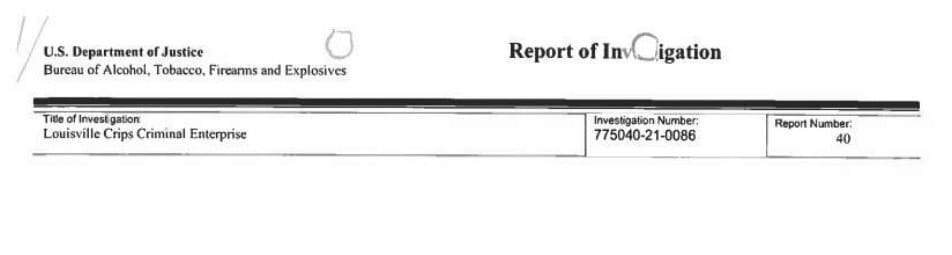
Gov’t’s Exh. 113, proffered at R. 133, Tr., PageID 2585. The district court said it “did not see” the words “Louisville Crips Criminal Enterprise” when the exhibit was first published to the jury. R. 133, Tr., PageID 2586.
Defendants twice requested mistrials based on that evidence, but the district court rebuffed them each time. The district court rejected the first request because the witness accused neither defendant of being part of a gang. The district court rejected the second request because the offending evidence “was up for a very brief period of time . . . .” Id. at PageID 2587.
Third, the Government did not prosecute Stewart pursuant to a pretrial diversion agreement. The diversion agreement said that Stewart “committed an offense against the United States”—possession with intent to distribute narcotics—and that she would cooperate with the Government in exchange for not being prosecuted. Horton’s App’x at 0001–02. But when Horton’s counsel asked about the diversion agreement on cross, Stewart denied committing any crimes. When Horton tried to admit a copy of the diversion agreement, the district court refused because the diversion agreement did not include an admission of guilt as to any specific crime.
After a week-long trial, the jury found both Horton and Summers guilty on all relevant counts. Horton was sentenced to a total of 336 months in prison and five years of supervised release. Summers was sentenced to a total of 300 months in prison and five years of supervised release. Both men appealed, and we consolidated the appeals.
II.
Horton and Summers raise several challenges to their convictions. We address below whether (a) the Government sufficiently proved defendants possessed a firearm in furtherance of drug trafficking, (b) a mistrial was warranted over references to gangs, (c) the jury instructions were plainly erroneous, and (d) the challenged evidentiary rulings impacted the outcome of the trial.
A.
To start, we conclude that the Government presented sufficient evidence to convict Horton and Summers of possessing a firearm in furtherance of drug trafficking under 18 U.S.C. § 924(c). “We review a challenge to the sufficiency of the evidence in a criminal case de novo.” United States v. Woods, 14 F.4th 544, 551 (6th Cir. 2021). We view the facts in the light most favorable to the Government, drawing all reasonable inferences in its favor. See United States v. Gooding, 351 F.3d 738, 740–41 (6th Cir. 2003). We must determine whether “any rational trier of fact could have found the essential elements of the crime beyond a reasonable doubt.” United States v. Amawi, 695 F.3d 457, 475 (6th Cir. 2012) (quoting United States v. Humphrey, 279 F.3d 372, 378 (6th Cir. 2002)) (emphasis in original). “Circumstantial evidence alone can defeat a sufficiency challenge.” Woods, 14 F.4th at 551 (cleaned up).
Congress has imposed enhanced mandatory minimum sentences for defendants who “possess[] a firearm” “in furtherance of” “any crime of violence or drug trafficking crime . . . .” 18 U.S.C. § 924(c)(1)(A). To win a guilty verdict, the Government must prove the defendant “(1) possessed a firearm, (2) committed a drug-trafficking crime, and (3) possessed the firearm in furtherance of that crime.” United States v. London, 175 F.4th 805, 820–21 (6th Cir. 2026).
Defendants briefed only the last element, and a defendant preserves challenges to his conviction on an element-by-element basis, so we will focus our attention on that one.1. In a point heading, Horton says that “the United States did not admit sufficient evidence of guilt against defendant Horton as to several alleged offenses.” Horton’s Appellant’s Br. at 13 (bolding and capitalization altered). But only Count 5 of the Second Superseding Indictment charged Horton with violating § 924(c)(1)(A), and the body of his brief lacks any argument regarding the other charges. Thus, to the extent Horton contests the sufficiency of the evidence on any other counts, we do not consider those arguments because they have not been adequately briefed. See, e.g., United States v. Lopez-Medina, 461 F.3d 724, 748 n.6 (6th Cir. 2006). See id. at 821. To satisfy that element, the Government must establish “a specific nexus between the gun found and the crime charged.” Id. More concretely, the Government must prove that the firearm was “possessed for the purpose of aiding or furthering a drug trafficking crime.” Id. The Government can do this by, among other things, proving that the defendant “own[ed] a gun to protect the drugs, the proceeds of drug sales, or the dealer himself.” United States v. Maya, 966 F.3d 493, 500 (6th Cir. 2020) (quoting United States v. Bailey, 882 F.3d 716, 721 (7th Cir. 2018)) (quotation marks omitted).
Defendants possessed their firearms in furtherance of drug trafficking. They were seen with firearms in their pants pockets and waistbands while at two drug dens. Moreover, defendants were caught disposing of drug precursors at the same properties where they were caught on video carrying the guns. This suggests that those properties were important locations for the drug trafficking conspiracy. Those locations would thus likely be the target of violence from rival traffickers, and most drug traffickers would not call the police to protect their stash of illegal drugs. A rational juror could easily conclude that defendants had firearms on them to protect themselves at those locations.
In arguing against this outcome, defendants distort the evidence and ignore the standard of review. Horton, for example, protests that the Government found “scant[] evidence connecting him to possible drug crimes.” Horton’s Appellant’s Br. at 2 (bolding and capitalization altered). But that ignores the scales, massive quantities of drugs, and ledgers at two properties Horton regularly entered with a key. Summers, for his part, says that he never had a firearm “in connection with drug activity” despite bringing the gun to two drug dens. Summers’s Appellant’s Br. at 33 (bolding and capitalization altered). We struggle to see how Summers can plausibly make that argument while giving the Government the benefit of all possible inferences from the evidence, especially given our recognition that carrying a gun for protection while being part of a drug trafficking conspiracy violates § 924(c). See Maya, 966 F.3d at 500.
We therefore find sufficient evidence to support both defendants’ convictions.
B.
We also reject both defendants’ requests for a mistrial. We review the denial of a mistrial for an abuse of discretion. United States v. Howard, 621 F.3d 433, 458 (6th Cir. 2010). A district court abuses its discretion when it “relies on clearly erroneous findings of fact, uses an erroneous legal standard, or improperly applies the law.” United States v. Elias, 984 F.3d 516, 520 (6th Cir. 2021) (quoting United States v. Flowers, 963 F.3d 492, 497 (6th Cir. 2020)). We may not reverse without “a definite and firm conviction that the trial court committed a clear error of judgment.” Flowers, 963 F.3d at 497 (quoting Landrum v. Anderson, 813 F.3d 330, 334 (6th Cir. 2016)).
“[A] mistrial is a drastic remedy that results in additional expense to the judicial system as well as to all the parties.” United States v. Smith, 44 F.3d 1259, 1268 (4th Cir. 1995). Because a mistrial is such a severe remedy, a defendant seeking one must show that the inappropriate testimony was “so clearly improper and prejudicial . . . that the harm could not be erased by any instruction which the court might give.” United States v. Smith, 601 F.3d 530, 538 (6th Cir. 2010) (quoting United States v. Rudolph, 403 F.2d 805, 806 (6th Cir. 1968)). We are therefore less likely to require a mistrial when the impugned evidence is framed to “minimize[]” any prejudice to the defendant, Howard, 621 F.3d at 459, or when the impugned evidence constitutes “only a small part of the evidence against [the] defendant,” United States v. Forrest, 17 F.3d 916, 920 (6th Cir. 1994) (per curiam). Finally, a defendant is not entitled to a mistrial simply because he successfully moved to exclude certain evidence. See Smith, 601 F.3d at 538.
The district court did not abuse its discretion in denying the mistrial. To grant such a remedy would be too drastic a response to the jury seeing two inconsequential pieces of evidence. One was a passing comment in a direct examination where an officer said that he specialized in gang investigations to establish his general law enforcement credentials, and the other was a document where the words “Louisville Crips Criminal Enterprise” were printed on the top of the document in small font. Neither defendant gives us a basis for disturbing the district court’s factual finding that nobody saw the second piece of evidence, and the impugned evidence comprises barely ten words in a week-long, eight-count drug trafficking trial.
We therefore affirm the denial of the motions for a mistrial.
C.
We next reject Summers’s challenge to the district court’s instruction on the applicability of § 924(c). Summers concedes that he did not preserve his instructional challenge, so we will review only for plain error. See United States v. Sims, 975 F.2d 1225, 1240 (6th Cir. 1992). A district court does not plainly err unless “binding case law” directly “answers the question presented . . . .” United States v. Al-Maliki, 787 F.3d 784, 794 (6th Cir. 2015).
Summers argues that the district court was required to issue a specific unanimity instruction as to the date and time when he carried the firearm in furtherance of drug trafficking. But he does not point to any binding case law saying as much, and we cannot find any.
Under the Sixth Amendment, a defendant may not be convicted of a crime unless the jury “unanimously finds that the Government has proved each element” of the offense beyond a reasonable doubt. Richardson v. United States, 526 U.S. 813, 817 (1999). Thus, “the jury must unanimously decide that all facts that constitute ‘elements’ of a crime occurred, but it does not necessarily need to be unanimous” in deciding what those facts were. United States v. Hendrickson, 822 F.3d 812, 822–23 (6th Cir. 2016). Unsurprisingly, we have never held that the jury must unanimously agree on the date and time when the defendant possessed the firearm. That is enough to reject Summers’s objection on plain error review. See Al-Maliki, 787 F.3d at 794.
But the problem for Summers goes one step further. The mere fact that a jury must unanimously agree on an issue does not mean that the defendant is entitled to a specific unanimity instruction on that issue. Rather, we generally use a three-part test for determining when a specific unanimity instruction is warranted, see generally United States v. Miller, 734 F.3d 530, 538 (6th Cir. 2013), and we have never applied that test as part of a holding to a factual scenario similar to the one we have here.
Summers relies heavily on United States v. Steele, where we endorsed a district court’s decision to “task[] the jury with deciding unanimously on one instance of firearm possession in furtherance of a drug trafficking crime . . . .” 919 F.3d 965, 973 (6th Cir. 2019). This reliance is misplaced. We never said that doing so was necessary in that case, and we certainly did not say that doing so is necessary in all § 924(c) cases like the one before us. True, Steele contemplated scenarios where the Richardson principle would be inapplicable; if a jury convicts with wildly diverging understandings of the “means,” it would “risk[] serious unfairness and lack[] support in history or tradition.” Id. (quoting Richardson, 526 U.S. at 820). But no such scenario obtained in Steele, and it does not obtain here, either. So even if Steele’s dicta supported Summers’s argument, it would be insufficient to establish plain error. See United States v. Whren, 111 F.3d 956, 960– 61 (D.C. Cir. 1997); see also Al-Maliki, 787 F.3d at 794 (“A lack of binding case law that answers the question presented will also preclude our finding of plain error.”).
We therefore hold that the district court’s jury instructions were not plainly erroneous.
D.
Finally, we reject Horton’s and Summers’s evidentiary challenges because any claimed error was harmless, and we may not reverse over harmless error. See United States v. Freeman, 730 F.3d 590, 595 (6th Cir. 2013).
We start with Horton. He alleges that he should have been allowed to admit a copy of the diversion agreement that Stewart signed with the Government to impeach her credibility when she said that she did not commit any drug offenses. Any error from exclusion of the diversion agreement was harmless.
The colloquy between Stewart and Horton’s counsel on the diversion agreement takes up over twenty pages of the trial transcript. During that colloquy, Horton’s counsel had the opportunity to ask what the agreement said, and he did so at length. Moreover, the jury saw evidence that Stewart entered and left a drug den, lived at a drug den, and had illegal narcotics in her clothes. The diversion agreement would have been cumulative of all the other evidence showing that Stewart committed drug crimes. Moreover, if the jury sincerely believed, in the face of all that evidence, that Stewart had not committed drug offenses, then nothing would have convinced it otherwise. Because the diversion agreement would have been cumulative evidence, and because the outcome would not have changed with its admission, any error in excluding the diversion agreement was harmless. See, e.g., United States v. Agrawal, 97 F.4th 421, 430 (6th Cir.), cert. denied, 145 S. Ct. 258 (2024).
The same is true with Summers. He alleges that the district court should not have admitted evidence of him wearing “Victory Park” clothing, arguing that its admission was substantially more prejudicial than probative. See Fed. R. Evid. 403. But the evidence against Summers was so overwhelming that excluding the clothing would not have altered the outcome. See, e.g., United States v. Hardy, 643 F.3d 143, 154 (6th Cir. 2011). After all, Summers was caught on video entering two drug dens, often with a key and sometimes carrying a gun. A jury could easily have concluded, based on that evidence alone, that Summers was guilty of all the crimes alleged.
III.
For these reasons, the district court’s judgments are AFFIRMED.