NOT RECOMMENDED FOR PUBLICATION
UNITED STATES COURT OF APPEALS FOR THE SIXTH CIRCUIT
The Scotts Co. LLC v. The Procter & Gamble Co.
ON APPEAL
BeforeBOGGS, BATCHELDER, and MOORE, Circuit Judges.
View the official PDF → · unofficial reading copy; the court’s PDF controls
BOGGS, Circuit Judge. This is a trade-dress infringement and dilution case on interlocutory appeal from the denial of a preliminary injunction. The Scotts Company LLC (“Scotts”) seeks a preliminary injunction against The Procter & Gamble Company (“P&G”) for trade-dress infringement and dilution, alleging that P&G’s weed-killer product Spruce infringes on and dilutes Scotts’s Miracle-Gro trade dress. The district court denied Scotts’s motion for a preliminary injunction on the grounds that it is not likely to succeed on the merits of either claim.
For the reasons stated below, we affirm.
BACKGROUND
The Scotts Company LLC is an Ohio company with its principal place of business in Marysville, Ohio. OMS Investments, Inc., is a Delaware corporation with its principal place of business in Los Angeles, California. OMS owns the trade-dress rights to the Miracle-Gro brand of plant food and lawn and garden products, and licenses that trade dress to The Scotts Company. Investments, Inc. and The Scotts Company LLC (collectively, “Scotts”) own and use U.S. Trademark Registration No. 2,139,929, which “consists of a rectangular shaped box in the colors green and yellow” for “plant food.” Scotts also asserts a common-law trade dress that goes beyond that Registration. Scotts identifies the Miracle-Gro common-law trade dress as having five elements:
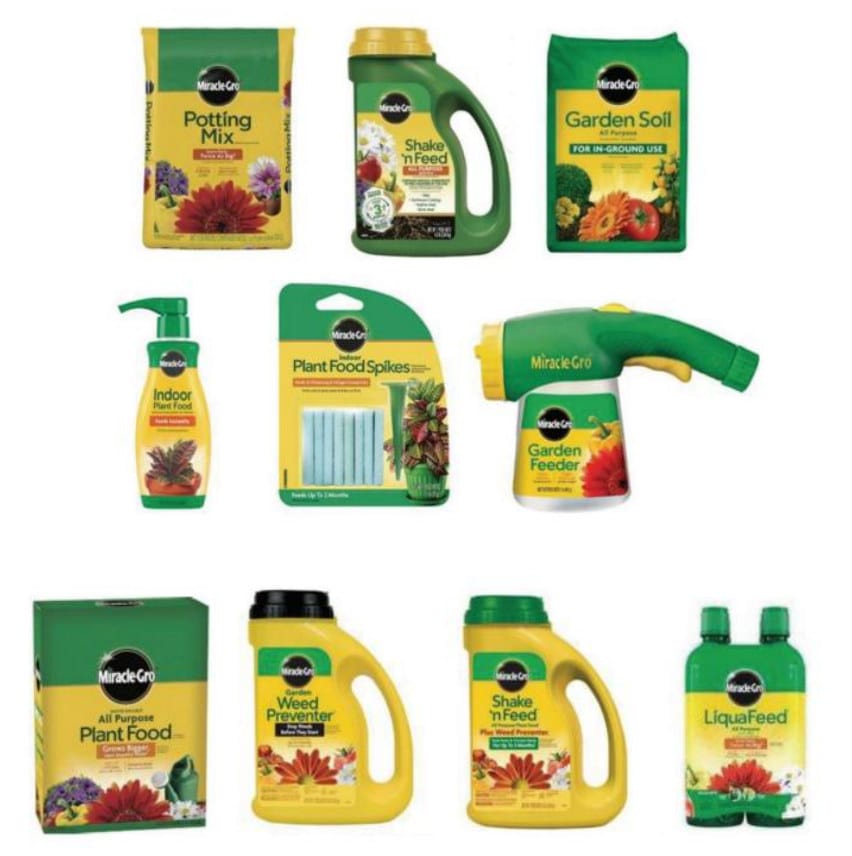
(1) A green and yellow color combination;
(2) With each color presented as a separate horizontal band and the top color taking up a smaller ratio than the bottom color;
(3) With the two bands sharing a common border that runs horizontally along the package;
(4) With a straight line dividing the two colored bands; and
(5) A circular horizontally centered graphic element.
The Miracle-Gro line of plant food and lawn and garden products looks like this:
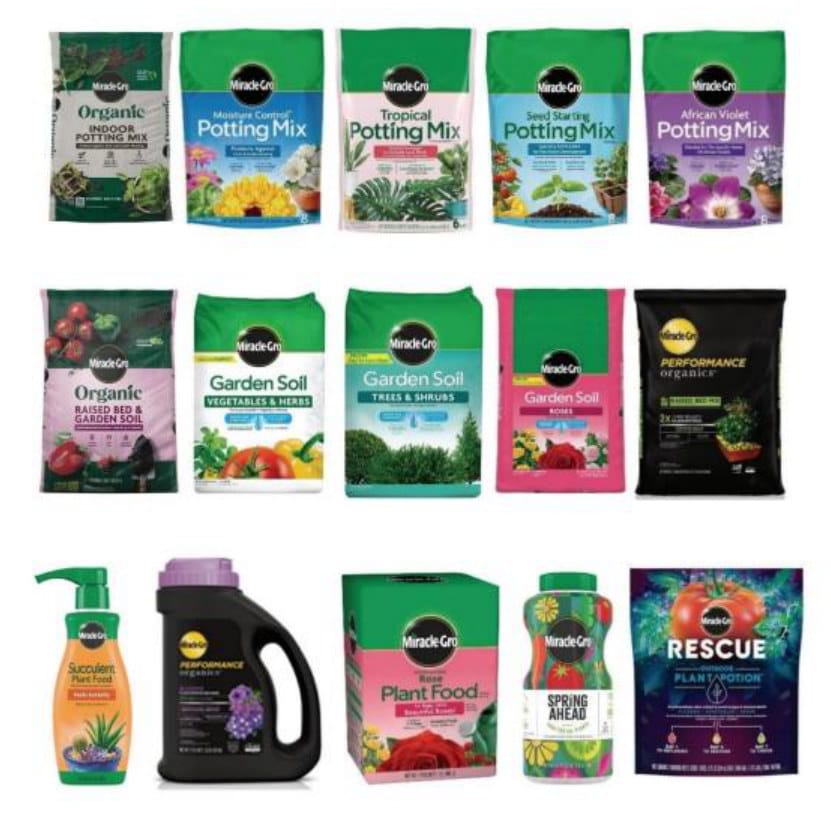
There are also a number of Scotts’s Miracle-Gro products that do not exhibit the trade dress. Approximately one-third of Scotts’s Miracle-Gro products, by revenue, are “specialty products” that come in different packaging. Here are some examples:
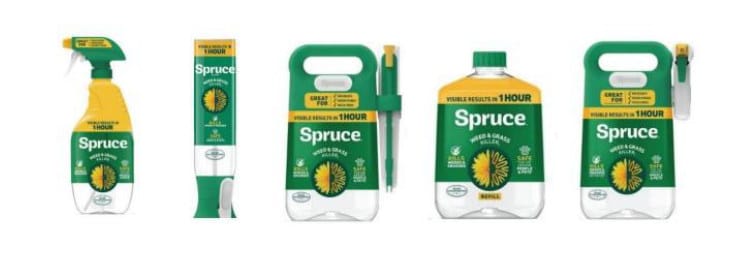
The Procter & Gamble Company (“P&G”) is an Ohio corporation headquartered in Cincinnati, Ohio. P&G released a non-selective herbicide product—or “weed killer”—branded “Spruce” in November 2024. The Spruce packaging looks like this:
Finally, there are a number of third-party products in the lawncare space, some of which are “widely sold in the lawn-and-garden marketplace,” and at times “shelved right next to” Miracle-Gro product. Some of those examples look like this:

Shortly after Spruce’s release, on November 25, 2024, Scotts filed suit and moved for a preliminary injunction. Scotts brought six claims: (1) trade-dress infringement under 15 U.S.C. § 1114(1); (2) false designation of origin and unfair competition under 15 U.S.C. § 1125(a); (3) trade-dress dilution by blurring and tarnishment under 15 U.S.C. § 1125(c); (4) Ohio law deceptive trade practices; (5) common-law unfair competition; and (6) false advertising.1. The parties stipulated that the false-advertising claim would not be addressed for the purposes of the Motion for Preliminary Injunction. Scotts Co. v. Procter & Gamble Co., 2026 U.S. Dist. LEXIS 35088, at *4 (S.D. Ohio Feb. 20, 2026). Scotts seeks declaratory and injunctive relief: an order under 15 U.S.C. § 1118 requiring P&G to destroy all violative products and materials; recalls of product packaging, advertisements, and promotions; notifications to customers, retailers, distributors, and vendors of the judgment; direct and indirect damages in the form of P&G’s profits from Spruce; and attorneys’ fees and costs. P&G asserted two counterclaims seeking (1) cancellation of Scotts’s registration under 15 U.S.C. § 1064 and (2) a declaratory judgment that Scotts’s alleged trade dress is neither protectable nor enforceable.
The district court permitted limited discovery and conducted a preliminary-injunction hearing. The district court denied Scotts’s request for a preliminary injunction, holding that Scotts had not shown a strong likelihood of success on the merits of its infringement and dilution claims, that Scotts had not demonstrated irreparable harm in the absence of a preliminary injunction, that the balance of the harms did not favor Scotts, and that public-interest factors similarly did not favor Scotts. Scotts Co. v. Procter & Gamble Co., 789 F. Supp. 3d 539, 582–83 (S.D. Ohio 2025).
This appeal followed.
ANALYSIS
We review a district court’s denial of a preliminary injunction for abuse of discretion. McGlone v. Bell, 681 F.3d 718, 728 (6th Cir. 2012). “We will hold that the district court erred only if it incorrectly applied the law, or relied on clearly erroneous findings of fact.” Golden v. Kelsey- Hayes Co., 73 F.3d 648, 653 (6th Cir. 1996). “We therefore review the district court’s conclusions of law de novo and its findings of fact for clear error.” Ibid. (citing Performance Unlimited v. Questar Publishers, Inc., 52 F.3d 1373, 1381 (6th Cir. 1995)).
A preliminary injunction is an “extraordinary remedy that may only be awarded upon a clear showing that the plaintiff is entitled to such relief.” Winter v. Nat. Res. Def. Council, Inc., 555 U.S. 7, 22 (2008). The plaintiff, as “[t]he party seeking the preliminary injunction[,] bears the burden of justifying such relief.” McNeilly v. Land, 684 F.3d 611, 615 (6th Cir. 2012). We consider four factors when deciding whether to issue a preliminary injunction: “(1) whether the movant has a strong likelihood of success on the merits; (2) whether the movant would suffer irreparable injury without the injunction; (3) whether issuance of the injunction would cause substantial harm to others; and (4) whether the public interest would be served by the issuance of the injunction.” Speech First, Inc. v. Schlissel, 939 F.3d 756, 763 (6th Cir. 2019) (citation modified).
Scotts argues that the district court erred in determining it was not likely to succeed on the merits of its trade-dress infringement and trade-dress dilution claims.
A. Likelihood of Success on the Merits of Trade-Dress Infringement
Section 43(a) of the Lanham Act, 15 U.S.C. § 1125(a), protects the unregistered “trade dress” of a product from infringement. “[T]o recover for trade-dress infringement under § 43(a), a party must prove by a preponderance of the evidence: 1) that the trade dress in question is distinctive in the marketplace, thereby indicating the source of the good it dresses, 2) that the trade dress is primarily nonfunctional, and 3) that the trade dress of the competing good is confusingly similar.” Abercrombie & Fitch Stores, Inc. v. Am. Eagle Outfitters, Inc., 280 F.3d 619, 629 (6th Cir. 2002). “[T]he third element is the standard for evaluating infringement.” Ibid.
This court addresses likelihood of confusion as a mixed question of fact and law. Wynn Oil Co. v. Thomas, 839 F.2d 1183, 1186 (6th Cir. 1988). We “apply a clearly erroneous standard to findings of fact supporting the likelihood of confusion factors, but review de novo the legal question of whether, given the foundational facts as found by the lower court, those factors constitute a ‘likelihood of confusion.’” Ibid. We use the eight Frisch factors to assess likelihood of confusion: (1) strength of the plaintiff’s mark; (2) relatedness of the services; (3) similarity of the marks; (4) evidence of actual confusion; (5) marketing channels used; (6) likely degree of purchaser care and sophistication; (7) intent of the defendant in selecting the mark; and (8) likelihood of expansion of the product lines using the mark. Homeowners Grp., Inc. v. Home Mktg. Specialists, 931 F.2d 1100, 1106–07 (6th Cir. 1991); Frisch’s Rests., Inc. v. Elby’s Big Boy of Steubenville, Inc., 670 F.2d 642, 648 (6th Cir. 1982).
In its appeal, Scotts objects to the district court’s treatment of three of these eight factors: (1) strength of the plaintiff’s mark, (2) similarity of the marks, and (3) relatedness of the goods. We address each in turn.
1. Strength of the Plaintiff’s Mark
The district court held that the strength of the trade dress “weighs at least somewhat in Scotts’ favor” because it found that the trade dress had substantial commercial strength but less conceptual strength. Scotts Co., 789 F. Supp. 3d at 575. Scotts argues that the district court erred because the finding of substantial commercial strength should be sufficient to make the factor weigh entirely in Scotts’s favor. Scotts is wrong.
“[T]he strength of a trademark for purposes of the likelihood-of-confusion analysis depends on the interplay between conceptual and commercial strength.” Maker’s Mark Distillery, Inc. v. Diageo N. Am., 679 F.3d 410, 419 (6th Cir. 2012). We have held that “[a] mark cannot be strong unless it is both conceptually and commercially strong.” Kibler v. Hall, 843 F.3d 1068, 1073 (6th Cir. 2016). In Kibler, we found that a mark that was “strong conceptually, but weak commercially” favored the defendants. Id. at 1076. Scotts attempts to argue that this can’t work the other way around—that a commercially strong mark is strong regardless of the conceptual strength of the mark. But the factor is based on “the interplay between conceptual and commercial strength” and that interplay should be evaluated in any case. And as the district court appropriately noted, even though Scotts has invested “substantial effort and large sums of money over an extended period of time” in promoting the trade dress, “there’s nothing particularly distinct about using green and yellow for packaging in the lawn care industry.” Scotts Co., 789 F. Supp. 3d at 573–74. We have held that “extensive third party use of similar marks” does “weaken[] a mark because the mark is not an identifier for a single source.” Progressive Distrib. Servs. v. UPS, Inc., 856 F.3d 416, 429 (6th Cir. 2017) (citation modified). A number of other products in the lawn-and- garden space use green and yellow combinations and those products perform well in the market. This limited conceptual strength does in fact reduce the strength of the mark.
The district court correctly applied the law in determining that the strength of the plaintiffs’ mark only “somewhat” favored the plaintiffs.
2. Similarity of the Marks
Scotts raises two objections to the district court’s analysis of the similarity of the marks. First, it argues that the district court erred as a matter of law by “rel[ying] on a legally improper side-by-side comparison of the packages in the courtroom,” and second, it argues that the court made the “clearly erroneous” factual finding that the Miracle-Gro trade dress always uses the same ratio of green and yellow. Appellant’s Br. at 12–13.
First, Scotts argues that “[t]he district court made its evaluation only within the context of the courtroom, without any discussion or findings of the marketplace conditions or consumers’ behavior within the marketplace.” Appellant’s Br. at 24. According to Scotts, the district court erred in directly comparing Scotts’s trade dress to Spruce’s packaging, because trade-dress- similarity analysis does not rest on a side-by-side, element-by-element comparison. See, e.g., Homeowners, 931 F.2d at 1109. But while this court “do[es] not approach trade dress claims by parsing minute differences between products,” Innovation Ventures, LLC v. N2G Distrib., Inc., 763 F.3d 524, 537 (6th Cir. 2014), that does not mean that actually comparing the packaging is inappropriate. Indeed, this court has held that the similarity factor is best assessed “by actually comparing the [plaintiff’s] packaging with the [defendant’s] packaging.” Gray v. Meijer, Inc., 295 F.3d 641, 648 (6th Cir. 2002). The district court identified the appropriate legal standard: “[W]hether a given mark would confuse the public when viewed alone, in order to account for the possibility that sufficiently similar marks may confuse consumers who do not have both marks before them but who may have a general, vague, or even hazy impression or recollection of the other party’s mark.” Scotts Co., 789 F. Supp. 3d at 576 (quoting Maker’s Mark, 679 F.3d at 421). And it assessed the “general impression” created by the two competing packages. Id. at 577. The district court appropriately held that the “overall visual impression” was dissimilar, with disparities in “size, shape, color, or color combinations, [and] graphics.” Id. at 578 (quoting Abercrombie, 280 F.3d at 629, 647) (alteration in original). And while the district court cited a variety of individual visual differences, it did so to show that the “visual differences add up to a highly dissimilar overall visual impression between the Miracle-Gro Trade Dress and the Spruce packaging.” Ibid.
Nor was the district court unaware of the context in which consumers might view the products. The district court correctly noted that “[t]he products at issue are typically not displayed side-by-side in a retail setting.” Id. at 579. Accordingly, the district court’s analysis of the visual impression did not rely on customers’ making a side-by-side comparison of the packaging; it instead noted that the differences “create[d] . . . distinct visual impression[s].” Id. at 578. This analysis does not depend on consumers parsing technical differences through direct comparison: it is an appropriate analysis of whether customers’ “impression or recollection” of the marks would be distinct, even if encountered separately. Scotts objects to the fact that the district court recognized that the shades of green were “very distinct,” but in no way does identifying a difference in color require that the packaging to be viewed side-by-side. Id. at 577. And in contrast to Scotts’s complaint that the district court ignored market conditions, it also objects to the district court’s considering the impression “when viewed in person,” which is often exactly how the products would be encountered in the market. Ibid.
The district court appropriately identified and applied the law in determining that the similarity factor “weigh[ed] heavily in P&G’s favor.” Id. at 578.
Second, the finding that Miracle-Gro trade dress uses the same ratio of green and yellow is not clearly erroneous. Scotts’s registration defines a specific one-third green to two-thirds yellow color combination. And while Scotts claims a broader common-law trade dress, Scotts’s expert, Mr. Sass, testified that “our Miracle-Gro trade dress says typically one-third green on top, two- thirds yellow on the bottom.” R. 68, PageID 5692. Scotts attempts to emphasize the “typically” qualifier, but Mr. Sass repeated the identification later, identifying the Miracle-Gro packaging as “start[ing] with roughly one-thirds green on the top and then yellow on the bottom.” Id. at PageID 5693. And he also described “the one-third/two-third” as part of “the iconic Miracle-Gro packaging” and mentioned the “one-third/two-third” ratio repeatedly as a key factor that distinguishes Miracle-Gro from a multitude of other green and yellow products. Id. at 5594, 5618.
Scotts points out that some Miracle-Gro products use other ratios of green and yellow. This is true. But some of the products that Scotts cites as using other ratios also completely lack other elements that Scotts identified as part of its broader common-law trade dress: for example, the products with “green at the top and bottom” have three colored bands, not the two colored bands described in both varieties of the trade dress. Appellant’s Br. at 37 (emphasis added). Scotts can’t have its cake and eat it too; either the yellow-and-green combination is distinct from the many other green and yellow products on the market because of its specific ratio, or it isn’t nearly as distinct as Scotts claims.
Scotts itself put forward the evidence that the district court credited in determining that the one-third green, two-thirds yellow ratio was a part of the trade dress. It also repeatedly cited the “proportion of approximately 1/3 green on top and 2/3 yellow on bottom as typically found on the MIRACLE-GRO Trade Dress” as a differentiating factor between Miracle-Gro and third-party products in its own proposed findings of fact. R. 74, PageID 6365–66. Therefore, the district court did not clearly err in determining that the one-third green, two-third yellow ratio was a part of the trade dress.
3. Relatedness of the Goods
Finally, Scotts objects to the district court’s finding that the relatedness of the goods weighed in neither direction because the products were “only somewhat related.” Scotts Co., 789 F. Supp. 3d at 575–76. The district court held that, because Spruce is a weed killer and there is no equivalent product in the Miracle-Gro product line, the products are “only somewhat related” because the products are not “directly competitive.” Ibid.
The district court followed the appropriate law. This court uses three categories to assess the relatedness of the goods at issue: “(1) direct competition of services, in which case confusion is likely if the marks are sufficiently similar; (2) services are somewhat related but not competitive, so that likelihood of confusion may or may not result depending on other factors; and (3) services are totally unrelated, in which case confusion is unlikely.” Homeowners, 931 F.2d at 1108. The district court used this framework to determine that the services were “somewhat related” because both were lawn and garden products, but did not directly compete, and that therefore “the likelihood of confusion will turn on other factors.” Kellogg Co. v. Toucan Golf, Inc., 337 F.3d 616, 624 (6th Cir. 2003).
The district court squarely followed this court’s precedent and did not err in determining that the relatedness of the goods made confusion no more or less likely.
Because the district court did not err in its assessment of the strength of the plaintiffs’ mark, similarity of the marks, or relatedness of the goods, it did not err in holding that Scotts was not likely to succeed on the merits of its trade-dress-infringement claim.
B. Likelihood of Success on Trade-Dress-Dilution Claim
Scotts next argues that the district court erred in holding that its finding that the Miracle- Gro trade dress and Spruce’s packaging are “highly dissimilar” also means it is not likely to succeed on its dilution claim.
Dilution can be by “blurring” or “tarnishment.” “Dilution by blurring” is “association arising from the similarity between a mark . . . and a famous mark that impairs” the famous mark’s “distinctiveness.” 15 U.S.C. §1125(c)(2)(B). Tarnishment is “association arising from the similarity between a mark or trade name and a famous mark that harms the reputation of the famous mark.” 15 U.S.C. §1125(c)(2)(C).
This court has previously employed a five-part test for a federal dilution claim. “The senior mark must be (1) famous; and (2) distinctive. Use of the junior mark must (3) be in commerce; (4) have begun subsequent to the senior mark becoming famous; and (5) cause dilution of the distinctive quality of the senior mark.” Autozone, Inc. v. Tandy Corp., 373 F.3d 786, 802 (6th Cir. 2004) (quoting Kellogg Co. v. Toucan Golf, Inc., 337 F.3d at 616). In Autozone, this court held that “[t]he degree of similarity required for a dilution claim must be greater than that which is required to show likelihood of confusion” because “[t]he purpose of anti-dilution laws is to provide a narrow remedy when the similarity between two marks is great enough that even a noncompeting, nonconfusing use is harmful to the senior user.” Id. at 805–06 (quoting Jet, Inc. v. Sewage Aeration Sys., 165 F.3d 419, 425 (6th Cir. 1999)). Consequently, the district court, citing Autozone, held that since the degree of similarity was insufficient even under a likelihood-of-confusion standard, Scotts did not have a strong likelihood of success on its dilution claim. Scotts Co., 789 F. Supp. 3d at 582.
Scotts argues that Autozone is no longer good law. The Trademark Dilution Revision Act of 2006, Pub. L. No. 109-312, § 2, 120 Stat. 1730 (“TDRA”), revised the Federal Trademark Dilution Act subsequent to Autozone. The revised version of the law requires a showing of likely dilution instead of actual dilution. 15 U.S.C. § 1125(c)(1). It also provides a definition of dilution and instructs that:
For purposes of paragraph (1), “dilution by blurring” is association arising from the similarity between a mark or trade name and a famous mark that impairs the distinctiveness of the famous mark. In determining whether a mark or trade name is likely to cause dilution by blurring, the court may consider all relevant factors, including the following:
(i) The degree of similarity between the mark or trade name and the famous mark.
(ii) The degree of inherent or acquired distinctiveness of the famous mark.
(iii) The extent to which the owner of the famous mark is engaging in substantially exclusive use of the mark.
(iv) The degree of recognition of the famous mark.
(v) Whether the user of the mark or trade name intended to create an association with the famous mark.
(vi) Any actual association between the mark or trade name and the famous mark. 15 U.S.C. § 1125(c)(2)(B).
Scotts notes that other courts have now held that “[c]onsideration of a ‘degree’ of similarity as a factor in determining the likelihood of dilution does not lend itself to a requirement that the similarity between the subject marks must be ‘substantial’ for a dilution claim to succeed.” Starbucks Corp. v. Wolfe's Borough Coffee, Inc., 588 F.3d 97, 108 (2d Cir. 2009); see also Levi Strauss & Co. v. Abercrombie & Fitch Trading Co., 633 F.3d 1158, 1172 (9th Cir. 2011) (“the plain language of 15 U.S.C. § 1125(c) does not require that a plaintiff establish that the junior mark is identical, nearly identical or substantially similar to the senior mark in order to obtain injunctive relief”). And the Ninth Circuit added that while “similarity has a special role to play in the implementation of the new statute’s multifactor approach . . . Congress’s decision to make ‘degree of similarity’ one consideration in a multifactor list strongly suggests that it did not want ‘degree of similarity’ to be the necessarily controlling factor.” Levi Strauss, 633 F.3d at 1171–72.
Consequently, Scotts argues, the district court’s finding that its common-law trade dress and P&G’s Spruce packaging are “highly dissimilar” is insufficient to determine that there is no “association arising from the similarity” between the two marks that impairs the distinctiveness of Scotts’s trade dress. Instead, Scotts claims, the district court must consider all six factors identified in the statute. In response, P&G points out that the definition of dilution is dependent on some amount of similarity, and that the Ninth Circuit also held that while “a particular degree of similarity is not a threshold, similarity is the necessary predicate for dilution analysis.” Levi Strauss, 633 F.3d at 1173, n.12. The statutory text itself does not seem to mandate that the district court specifically weigh all six factors; it only states courts “may” consider “all relevant factors” and offers six examples. See 15 U.S.C. § 1125(c)(2)(B).
We do not need to resolve the question as to whether the heightened showing of similarity required by Autozone still applies. Instead, we assume without deciding that the similarity requirement is no longer heightened relative to a likelihood-of-confusion analysis. While the district court did note that “[t]he ‘similarity’ test for dilution claims is more stringent than in the infringement milieu,” it imported its persuasive analysis from the infringement context, where it had already found “a high level of dissimilarity.” Scotts Co., 789 F. Supp. 3d at 582 (citation modified). Since dilution definitionally requires similarity and some similarity is “the necessary predicate” for dilution analysis, a finding of a complete lack of similarity should strongly influence the dilution analysis. Even if the standard is not more stringent than the likelihood-of-confusion standard, it is still stringent enough to defeat the claim. Consequently, the district court’s findings regarding similarity strongly influence the trade-dress-dilution analysis and therefore any error, if it exists, was harmless. While the Ninth Circuit found that this type of error was not harmless in Levi Strauss, it did so because the “[u]se of the ‘identical or nearly identical’ standard permeated the court’s analysis and provided the basis upon which the [district] court evaluated the evidence.” Levi Strauss, 633 F.3d at 1174. That was not the case here: the district court borrowed its similarity analysis from its likelihood-of-confusion assessment, which properly used the less stringent standard and found the trade dress and Spruce packaging “highly dissimilar.”
The district court’s determination that the Spruce packaging and the Miracle-Gro trade dress were “highly dissimilar” was sufficient to hold in this case that Scotts was unlikely to succeed on the merits of its trade-dress-dilution claim.
CONCLUSION
For the reasons stated, we AFFIRM.